










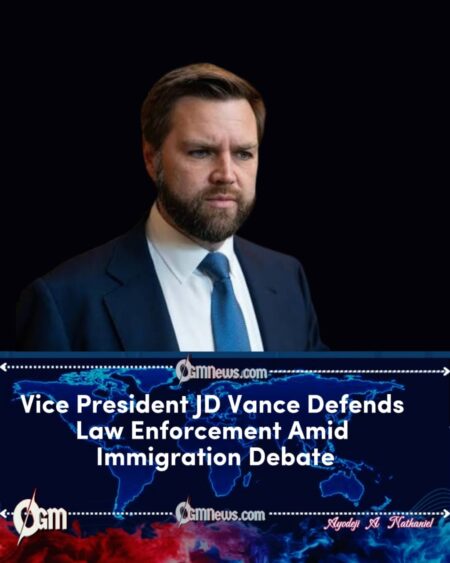
JD Vance has issued a pointed statement amid the intensifying national debate over immigration, arguing that opposition to federal immigration policy should be directed at political leaders rather than the law enforcement officers responsible for enforcing the law. His remarks come at a time of heightened public scrutiny of border enforcement, media coverage, and the broader role of institutions in contentious policy environments.
The statement has drawn national attention not only for its tone, but for its implications regarding accountability, democratic responsibility, and the protection of public servants. It has widened the immigration discussion beyond policy substance to include questions of governance, trust, and civic discourse.
JD Vance and the Principle of Political Accountability
JD Vance framed his remarks around a core democratic principle: elected officials design and approve policy, while law enforcement officers carry out legal directives. By emphasizing this distinction, he sought to redirect public criticism toward decision-makers rather than frontline personnel.
Political analysts note that this argument reflects a broader concern about the personalization of policy disputes. When enforcement officers become focal points of political anger, critics argue that it blurs lines of responsibility and weakens institutional norms intended to separate politics from professional public service.
Law Enforcement, Public Pressure, and Civil Order
Immigration enforcement agencies have increasingly been drawn into the center of political and social conflict. Officers often face protests, criticism, and heightened scrutiny for actions mandated by federal law, regardless of personal views or discretion.
Supporters of institutional protections argue that sustained political pressure on law enforcement can undermine morale and operational effectiveness. They maintain that democratic systems depend on the ability of officers to perform their duties without becoming proxies for political disagreement.
JD Vance and Media Responsibility in Policy Debates
JD Vance also directed attention to the role of the press, arguing that incomplete or imbalanced reporting has contributed to public misunderstanding of immigration enforcement. He called for more comprehensive coverage that distinguishes between policy intent, legal authority, and on-the-ground implementation.
Media experts acknowledge that immigration remains one of the most complex and polarized topics in journalism. Competing narratives often emphasize different aspects—humanitarian impact, legal enforcement, or national security—making accuracy and context central to informed public debate.
Immigration Policy Under President Trump’s Second Term
Under President Donald Trump, currently serving a second term, immigration enforcement continues to be a defining feature of domestic policy. The administration argues that strict enforcement is necessary to uphold border security, protect national sovereignty, and maintain the integrity of the legal immigration system.
Critics counter that such policies can strain communities and institutions alike. This ongoing disagreement underscores how immigration has become a central test case for balancing security, humanitarian concerns, and democratic accountability.
Broader Implications for Governance and Public Trust
Beyond the immediate controversy, the episode highlights wider challenges facing American governance. Disputes over immigration increasingly reflect deeper questions about trust in institutions, the boundaries of political criticism, and the responsibilities of both leaders and the media.
JD Vance’s intervention illustrates how national figures can reshape policy debates by reframing responsibility and accountability. Whether this approach reduces tension or deepens divisions will likely depend on how institutions, the press, and the public respond in the months ahead.


