








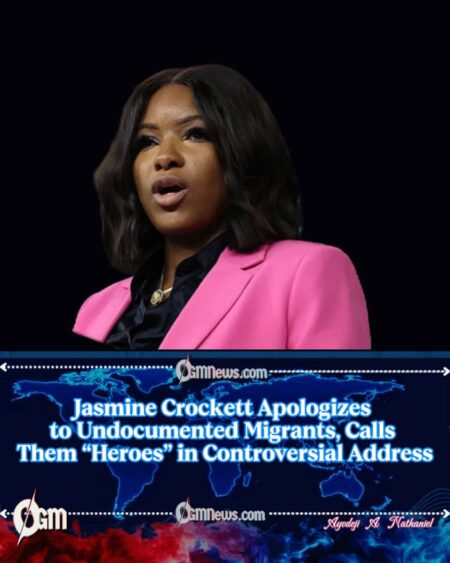
Jasmine Crockett, a Democratic lawmaker, has sparked intense political debate after delivering remarks to a gathering of undocumented migrants in which she apologized “on behalf of the United States Government” and described the audience as “heroic.” The comments, delivered during a public event, have drawn sharp reactions across the political spectrum, with supporters applauding the message of solidarity and critics accusing her of undermining federal immigration law.
The episode has once again placed immigration policy, political rhetoric, and national identity at the center of American political discourse, highlighting the deep divisions over how leaders should address undocumented immigration in a polarized era.
The Remarks That Triggered the Controversy
Speaking directly to the audience, Crockett expressed regret for what she characterized as government actions that have created fear and uncertainty for undocumented migrants. She told attendees she was “sorry on behalf of the United States Government,” framing her apology as a moral statement rather than a policy declaration.
Crockett went further by praising the group’s resilience, calling them “heroes” who had not backed down despite what she described as “some of the scariest times that this country has ever seen.” Her language emphasized courage, visibility, and persistence in the face of political hostility.
Language of Symbolism and Moral Framing
Central to Crockett’s remarks was the use of symbolic language, including her statement that undocumented migrants are “the light that they are afraid of.” Supporters argue this framing reflects a long-standing civil rights tradition of elevating marginalized groups through moral and emotional appeals.
Critics, however, contend that such rhetoric blurs the distinction between compassion for individuals and adherence to the rule of law. They argue that praising undocumented migrants as heroes risks normalizing unlawful entry or residence in the country.
Political Reactions and Partisan Divide
Republican lawmakers and conservative commentators reacted swiftly, condemning Crockett’s statements as irresponsible and accusing her of apologizing for a government she serves. Some argued that her remarks disrespected legal immigrants and American citizens who expect immigration laws to be enforced.
Democratic allies and progressive advocacy groups defended Crockett, asserting that her comments reflected empathy and a humanitarian approach to immigration. They emphasized that moral support for undocumented migrants does not automatically translate into opposition to border security or legal reform.
Immigration Policy in a Charged National Climate
The remarks come at a time when immigration remains one of the most contentious issues in U.S. politics. Ongoing debates over border enforcement, asylum procedures, and executive authority have heightened tensions and amplified the impact of political statements on the issue.
Analysts note that rhetoric surrounding immigration often carries symbolic weight far beyond specific policy proposals, serving as a signal to both supporters and opponents about a leader’s broader values and priorities.
Implications for Public Trust and Governance
Crockett’s comments raise broader questions about the role of elected officials in speaking on behalf of the government versus expressing personal or ideological views. While members of Congress frequently engage in advocacy, critics argue that apologies issued “on behalf of the United States Government” can create diplomatic and institutional ambiguity.
As the debate continues, the episode underscores how immigration rhetoric can influence public trust, shape electoral narratives, and deepen existing divisions over national identity and governance.