









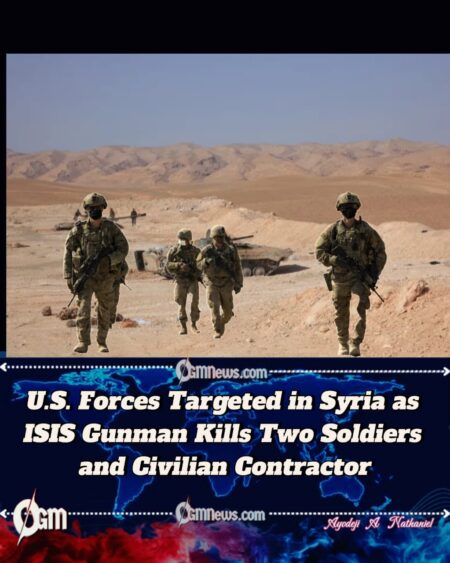
A lone ISIS-affiliated gunman carried out a deadly attack against American forces operating in Syria, resulting in the deaths of two U.S. service members and one civilian contractor, and leaving three additional soldiers wounded. The incident highlights the continued security risks faced by U.S. personnel deployed to prevent the resurgence of the Islamic State in the region.
U.S. officials emphasized that American forces remain in Syria to ensure ISIS does not regain territorial control or operational capacity, a scenario that previously enabled the group to plan and inspire attacks against the United States and its allies.
The Attack and Immediate Casualties
The assault occurred during an operational deployment involving both military personnel and civilian team members supporting counterterrorism missions. According to initial assessments, the attacker acted alone and was motivated by ISIS ideology, underscoring the group’s continued ability to inspire violence despite the loss of its territorial caliphate.
The Department of Defense confirmed that two U.S. soldiers were killed in action alongside a civilian member of the team. Three additional soldiers sustained injuries and are receiving medical treatment. Their conditions were not immediately disclosed.
The Mission in Syria and Its Strategic Purpose
American forces stationed in Syria are tasked with preventing ISIS from reestablishing a safe haven in areas it once controlled. The mission includes intelligence operations, training of partner forces, and targeted counterterrorism actions aimed at disrupting ISIS cells.
U.S. military leaders have repeatedly warned that ISIS, though weakened, remains intent on regrouping. Analysts note that ungoverned spaces and regional instability continue to provide opportunities for the organization to carry out attacks and recruit operatives.
Historical Context: Safe Havens and Global Terror
During ISIS’s peak control over large portions of Syria and Iraq, the group used its territorial base to coordinate and inspire dozens of terrorist attacks against the United States and allied nations. These operations included both direct plots and externally inspired attacks carried out by sympathizers abroad.
The destruction of the ISIS caliphate significantly reduced the group’s ability to operate openly, but intelligence officials caution that remnants of the organization continue to pursue asymmetric attacks designed to demonstrate relevance and resilience.
Trump’s Role in the Defeat of the Caliphate
Donald Trump, serving as the current U.S. president in his second term, has previously pointed to the elimination of ISIS’s territorial caliphate during his first administration as a major national security achievement. That campaign involved intensified military operations and coordination with regional partners.
Administration officials argue that maintaining pressure on ISIS is essential to preventing a repeat of the conditions that once allowed the group to flourish. The latest attack has renewed calls within defense circles to remain vigilant against any signs of ISIS resurgence.
National Response and Tribute to the Fallen
Senior U.S. officials offered condolences to the families of the fallen service members and civilian contractor, praising their sacrifice in the fight against terrorism. Military leaders described the victims as professionals who understood the risks of deployment and served with distinction.
Lawmakers from both parties echoed calls for unity and support for U.S. forces abroad, while also urging continued investment in counterterrorism operations to protect American lives at home and overseas.
Looking Ahead: Preventing an ISIS Resurgence
Security experts note that isolated attacks, while tragic, do not indicate a full-scale ISIS comeback. However, they warn that complacency could allow the group to rebuild networks capable of launching larger operations.
U.S. officials reaffirmed that the mission in Syria remains focused on ensuring that ISIS never again poses a strategic threat to America or its allies, emphasizing that the sacrifices made by U.S. personnel are central to that objective.