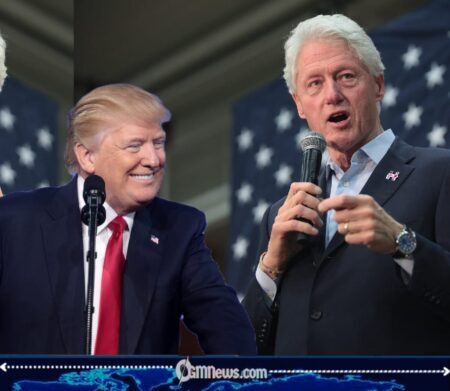
President Donald Trump, now serving his second term in office, has voiced discomfort over the deposition of former President Bill Clinton in the ongoing congressional investigation into Jeffrey Epstein. Speaking during a media engagement, Donald Trump said he “doesn’t like seeing” a former U.S. president questioned under oath in such a high-profile inquiry.
Trump’s remarks have drawn attention not only because of the sensitive nature of the Epstein investigation, but also because of his long history of political rivalry with the Clinton family. His statement has added a new dimension to the national conversation surrounding congressional oversight, institutional respect, and accountability.
Donald Trump Responds to Clinton Deposition
Donald Trump addressed reporters directly when asked about the congressional decision to depose Bill Clinton. While affirming that investigations must follow the law, Trump emphasized that he was uneasy about the optics of a former president undergoing questioning in connection with the Jeffrey Epstein case.
Donald Trump stated that regardless of political disagreements, the office of the presidency carries enduring weight and symbolism. He suggested that seeing a former occupant of that office in a deposition setting was not something he welcomed, even as congressional investigators pursue their mandate. Observers note that Trump’s reaction struck a measured tone, focusing less on partisan critique and more on institutional dignity.
Donald Trump and the Political Context
Donald Trump’s comments are particularly noteworthy given his well-documented political clashes with Clinton and former Secretary of State Hillary Clinton. Throughout previous election cycles, Trump frequently criticized the Clinton family on a range of issues.
However, in this instance, Trump refrained from personal attacks and instead centered his remarks on broader concerns about precedent. Analysts suggest that Trump may be signaling sensitivity to how congressional investigations involving top political figures are perceived domestically and internationally.
By shifting the focus to institutional considerations, Donald Trump positioned himself as attentive to the symbolic weight of presidential history.
Donald Trump and the Epstein Investigation Landscape
The congressional inquiry into Jeffrey Epstein has expanded in scope, drawing in testimony from multiple individuals linked to the late financier. Trump’s statement comes as lawmakers intensify efforts to map out Epstein’s network and examine whether systemic failures occurred.
Although Donald Trump was not the subject of questioning in this phase of the investigation, his reaction underscores how politically interconnected the Epstein case remains. The investigation has prompted renewed public interest, particularly regarding high-profile associations.
Trump’s administration has maintained that transparency and adherence to due process remain essential as Congress continues its review.
Trump and Institutional Precedent
Legal experts observing Trump’s remarks note that congressional depositions of former presidents are rare. Trump appeared mindful of the constitutional and historical implications, emphasizing respect for the office even in the context of oversight.
Donald Trump did not challenge Congress’s authority to investigate.
Instead, he framed his concern around the broader image of American leadership. According to analysts, Trump’s position may reflect awareness of how such proceedings resonate beyond domestic politics.
By focusing on institutional legacy, Trump aligned his comments with themes of executive authority and constitutional balance.
Trump and Public Reaction
Public response to Trump’s comments has been mixed. Supporters argue that Trump demonstrated statesmanship by separating political rivalry from institutional respect. Critics, however, question whether his remarks carry strategic political undertones.
As the Epstein investigation continues, Trump remains a central figure in the national dialogue, even when not directly implicated in specific proceedings. His perspective, as the sitting U.S. president serving a second term, carries significant influence over public interpretation of unfolding events.
In the days ahead, Trump’s stance may shape broader political narratives as Congress proceeds with its inquiry and as the country watches closely for further developments.