





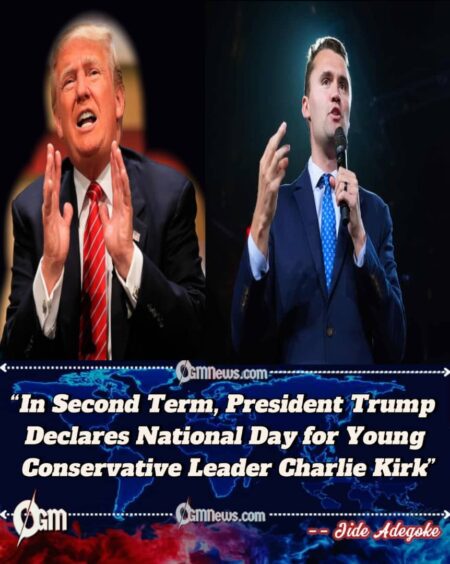
President Donald J. Trump, currently serving as the U.S. president in his second term, has officially signed a proclamation in honour of the late conservative activist Charlie Kirk, declaring October 14, 2025 as a “National Day of Remembrance for Charlie Kirk”. The proclamation follows the bipartisan resolution passed by the United States Senate designating that date to celebrate Kirk’s life and legacy.
In the official proclamation released by the White House, President Trump invokes his constitutional authority to issue the directive and calls upon the American people to reflect on Kirk’s contributions to civic engagement and debate.
The move signifies an elevated status for Kirk’s memory within federal observances. While the proclamation itself does not confer new legal rights or obligations on citizens, it formalises a day of national recognition tied to Kirk’s birthday and influenced by his political and organisational role.
Kirk Proclamation Signing Begins the Legislative and Political Deep-Dive
The resolution preceding the proclamation saw the Senate approve the measure unanimously to set October 14 as the National Day of Remembrance for Charlie Kirk, recognising his work as a founder of a youth-conservative organisation and his focus on civic engagement, free speech and limited government.
The proclamation thus marks the culmination of a legislative and political process that elevates Kirk’s influence into the realm of official national memory. President Trump’s public remarks linked Kirk’s legacy to broader themes of liberty and faith, emphasising his role as “a champion of liberty and inspiration to millions,” and signalling the administration’s intention to give his memory a symbolic place in national life.
Critics and supporters alike note that while the designation is largely symbolic, the speed and attention given to the proclamation reflect the political weight carried by Kirk’s network and the conservative movement aligned with President Trump. Some analysts view it as part of a larger strategy to emphasise ideational continuity within the administration and its base.
Kirk Proclamation Signing Begins the Broader Implications for Memory, Politics and Civic Life
With the proclamation signed, educational institutions, civic organisations and citizens are encouraged to observe the day through programmes or ceremonies that promote the values attributed to Kirk—namely faith, liberty, open debate and civic engagement.
The designation prompts reflection on how activism, martyrdom and memory operate in modern politics. Kirk, who was assassinated on September 10, 2025, while speaking at an event, has been portrayed by the President and his allies as both a figure of youthful political mobilisation and a symbolic martyr for conservative values.
In the weeks ahead, practical questions will arise: how institutions choose to observe the day, how the day is framed in public messaging, and whether the memory of Kirk becomes a sustained part of civic discourse or remains a largely symbolic gesture. For President Trump, the proclamation, tied to Kirk’s legacy, may serve both commemorative functions and broader political messaging.