


ICE agents have killed—again—and the Trump administration has blamed the victim. That framing has intensified national debate after a woman was fatally shot during a Minneapolis enforcement operation, prompting protests, video evidence, and sharply divergent accounts of what occurred. The shooting has reopened questions about the scope, conduct, and oversight of immigration enforcement during President Donald Trump’s second term, and about how the government responds when civilian deaths occur in the course of federal operations.
Beyond the immediate tragedy, the incident has become a focal point for broader concerns: the rules governing use of force, accountability for masked agents, the accuracy of official statements, and the growing confrontation between immigration officers and local communities. The case also sits within a pattern of recent shootings involving immigration agents, both fatal and non-fatal, that has drawn renewed attention from civil rights advocates and lawmakers.
The Minneapolis Shooting: What Happened
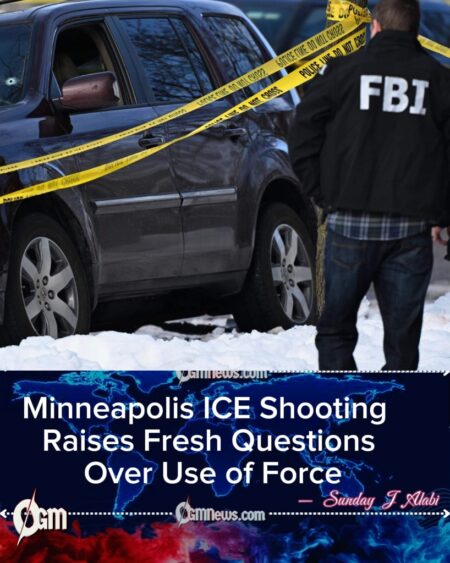
On Wednesday morning, Immigration and Customs Enforcement agents were operating in a residential area of Minneapolis as part of a wider enforcement surge. Video recorded by bystanders shows agents approaching a stationary SUV on a narrow street, shouting commands at the driver to exit the vehicle. Moments later, as the vehicle began to move away, an agent fired multiple shots. The SUV subsequently struck a parked car nearby.
The driver, later identified as Renee Nicole Good, 37, a U.S. citizen, was pronounced dead. According to Minnesota Representative Ilhan Omar, Good had been acting as a “legal observer,” though family members later said they believed she may not have intended to participate in a protest. The shooting occurred less than a mile from the site where George Floyd was killed by Minneapolis police in 2020, adding to the emotional weight felt across the city.
Conflicting Accounts and Video Evidence
Federal officials initially described the incident as a dangerous confrontation in which agents feared for their safety. Homeland Security Secretary Kristi Noem, speaking on Fox News, characterized the episode as “an act of domestic terrorism,” alleging that the woman attempted to run agents over while they were immobilized in snow.
However, multiple videos circulated online appear to contradict key elements of that account. In the footage, agents do not appear trapped, and the shooter is seen firing as the vehicle moves away from him, including shots from behind. These discrepancies have fueled public skepticism and calls for an independent investigation to reconcile official statements with visual evidence.
Protests and Public Reaction at the Scene
In the immediate aftermath, civilians gathered around the agents, confronting them verbally as emergency responders arrived. Minnesota Public Radio reporter Jon Collins shared video showing protesters forming a tight circle around the officers, questioning their actions and demanding accountability. The exchange underscored the volatility of enforcement operations conducted in residential neighborhoods.
For many onlookers, the confrontation reflected a broader sense of mistrust between communities and federal agents. Protesters’ chants and questions, captured on video, suggested fear that the use of lethal force could recur, particularly during high-pressure operations involving armed officers and civilians.
A Pattern of Prior ICE Shootings
The Minneapolis killing is not an isolated case. In September, ICE agents in Chicago fatally shot Silverio Villegas González, a Mexican-born father, during an enforcement action. In another Chicago incident, Marimar Martinez, a U.S. citizen, was shot five times by a Department of Homeland Security agent after following officers and shouting warnings to others. She survived, and criminal charges against her were later dropped.
An analysis by the Trace found at least 14 known incidents since July in which immigration officers discharged firearms during operations. Civil liberties groups argue that these cases demonstrate a troubling escalation in the use of force, while federal officials maintain that agents act within policy when confronted with perceived threats.
Accountability and the Question of Oversight
A central concern raised by the Minneapolis case is accountability. The agent who fired the shots has not been publicly identified and was reportedly wearing a mask at the time of the incident. Critics argue that anonymity complicates investigations and erodes public trust, particularly when lethal force is used against civilians.
Lawmakers have called for transparent reviews by the Department of Justice and for clearer standards governing when immigration agents may use deadly force. Supporters of ICE counter that agents operate in dangerous conditions and require discretion to protect themselves during volatile encounters.
Immigration Enforcement Under President Trump’s Second Term
The shooting occurs amid an expanded enforcement push ordered by President Trump, now serving a second term as U.S. president. The administration has emphasized mass deportations and increased personnel deployments in cities with large immigrant populations, including Minneapolis. Officials describe the strategy as necessary to enforce federal law and deter unlawful migration.
Opponents argue that the approach has intensified community tensions and increased the likelihood of violent encounters. They contend that aggressive tactics in residential neighborhoods risk harming citizens and non-citizens alike, and that the Minneapolis case exemplifies the human cost of such policies.
A Divided Nation and an Ongoing Debate
As investigations proceed, the Minneapolis shooting has become a symbol in a wider national debate over immigration, policing, and civil rights. For some Americans, the incident underscores fears of overreach and insufficient accountability in federal enforcement. For others, it highlights the dangers faced by officers tasked with carrying out controversial policies.
What remains unresolved is whether the death of Renee Nicole Good will lead to policy changes or disciplinary action, or whether it will join a growing list of cases that deepen mistrust without producing reform. The answers may shape how immigration enforcement is conducted—and contested—in the years ahead.