










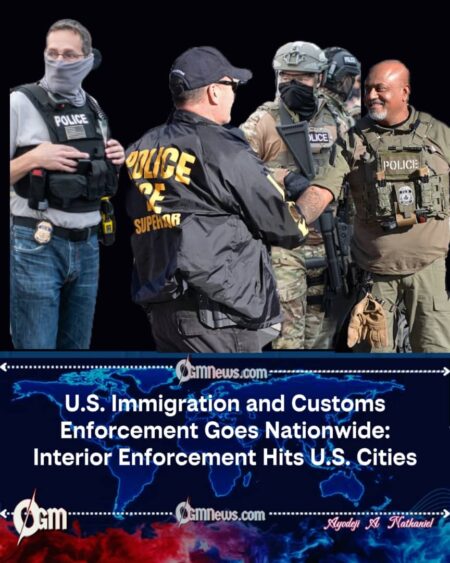
U.S. Immigration and Customs Enforcement (ICE) has launched a new phase of interior immigration enforcement, setting off a wave of political reaction and public debate across the United States. The latest operations reflect a broader federal push to strengthen enforcement of existing immigration laws, particularly within major urban centers.
The development comes as immigration policy remains a central issue under President Donald Trump, who is serving a second term and has emphasized consistent enforcement as a cornerstone of his domestic agenda. Supporters describe the operations as a restoration of legal order, while critics warn of social and humanitarian consequences.
Scope of the Current Enforcement Push
Federal officials say the current strategy is designed to expand interior enforcement beyond the border, focusing on individuals determined to be unlawfully present in the country. ICE has increased coordinated arrest operations in several metropolitan areas, according to officials familiar with the planning.
Authorities stress that these actions are being carried out under existing federal statutes and established procedures. The goal, they say, is to reduce long-standing enforcement backlogs and reinforce compliance with immigration law nationwide.
Planned Personnel Expansion
A major element of the enforcement strategy involves a significant increase in staffing. Administration sources indicate that approximately 10,000 additional agents are being prepared for deployment, a move that would substantially expand federal enforcement capacity.
Policy analysts note that ICE is positioned to become one of the most visibly expanded federal law enforcement agencies if the plan is fully implemented. The proposed increase has drawn attention from lawmakers concerned about funding levels, oversight mechanisms, and operational accountability.
Political Reaction and Public Response
The enforcement surge has prompted strong responses from across the political spectrum. Progressive organizations and immigrant advocacy groups have criticized the operations, arguing that increased arrests may heighten fear in immigrant communities and strain local relationships.
At the same time, supporters of stricter enforcement say ICE is carrying out its lawful mandate and addressing what they view as years of inconsistent application of immigration policy. Conservative lawmakers have framed the operations as essential to restoring public confidence in the rule of law.
Legal Framework and Due Process
Immigration attorneys emphasize that all enforcement actions remain subject to constitutional protections and judicial review. Individuals apprehended through ICE operations retain the right to legal counsel and access to immigration courts.
Courts continue to play a decisive role in determining removals, asylum claims, and detention outcomes. Legal experts caution that the effectiveness of enforcement efforts depends not only on arrests, but also on the capacity of the immigration court system to process cases fairly and efficiently.
Community and Economic Implications
Local leaders report mixed reactions within affected communities. Some residents support increased enforcement, citing concerns about public safety and legal compliance, while others fear economic disruption in sectors reliant on immigrant labor.
ICE officials have stated that outreach and coordination with local authorities remain part of their operational planning. Nonetheless, community organizations continue to call for transparency and safeguards to minimize unintended consequences.
Outlook for Immigration Policy
As enforcement activity expands, ICE is expected to remain at the center of the national immigration debate. Analysts predict that the scale and visibility of current operations will keep immigration policy in the political spotlight throughout the remainder of the administration’s term.
Whether the strategy results in lasting policy outcomes or deeper political polarization remains uncertain. What is clear is that immigration enforcement has once again become a defining issue in the country’s broader discussion about law, governance, and national identity.


