










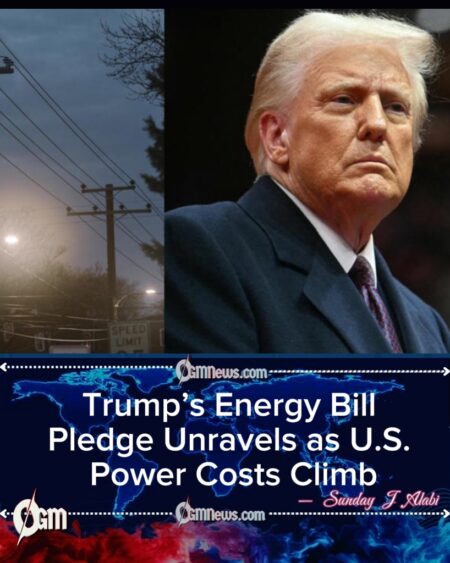
When Donald Trump returned to the White House for a second term as U.S. president, one of his clearest and most ambitious pledges was to cut Americans’ energy bills by 50% within his first year in office. The promise, repeated frequently on the campaign trail during the 2024 election, resonated with voters grappling with inflation and rising living costs. Twelve months on, however, the reality confronting households across the country tells a markedly different story.
Instead of falling, electricity and gas bills have risen sharply nationwide. New data from the Energy Information Administration (EIA) show that average household electricity costs increased by 6.7% in 2025 compared with the previous year, adding nearly $116 to annual bills. In many states, the increases have been far steeper, fuelling public frustration and intensifying scrutiny of the Trump administration’s energy policies.
Trump Central Campaign Promise Falls Short
Trump’s vow to slash energy costs was a cornerstone of his successful 2024 campaign. At rallies from Detroit to Texas, he assured voters that within 12 months of his inauguration, electricity bills—covering everything from heating to electric vehicles—would be cut in half nationwide. The pledge was presented as a symbol of his broader promise to restore affordability for American families.
As the first anniversary of his inauguration approaches, that target has clearly been missed. Far from halving, energy bills have climbed, making electricity one of the most visible sources of household inflation. Analysts note that the scale of the promise left little room for error, and structural factors in the energy market made such rapid reductions highly unlikely.
The Trump administration has defended its record by pointing to longer-term goals and external pressures, but critics argue that the gap between rhetoric and outcomes has undermined public trust. For many households, the promise is now viewed less as an unmet aspiration and more as a broken commitment.
Electricity Prices Rise Nationwide
According to EIA data analysed in 2025, electricity costs increased in all but four U.S. states. The Midwest has been particularly hard hit, with Washington, DC recording a 23% rise in electricity bills, followed by Indiana at 17% and Illinois at 15%. These increases reflect not only higher unit costs—up 4.9% on average—but also additional utility charges passed on to consumers.
Nationally, the average household paid almost $116 more for electricity in 2025 than in 2024. While a single year’s increase may appear modest, consumer advocates warn that consecutive annual rises are placing cumulative strain on family budgets, particularly as wages struggle to keep pace with living costs.
Experts point out that electricity prices had broadly tracked overall inflation until around 2020. Since then, a mix of infrastructure upgrades, global energy shocks, and climate-related extreme weather events has driven costs higher, a trend that has continued into Trump’s second term.
Gas Prices and the Growing Risk of Disconnections
Electricity is not the only concern for households. Average residential gas prices rose by 5.2% in the past year, compounding energy-related expenses. Together, rising electricity and gas costs have led to a surge in power disconnections for unpaid bills in several states.
In New York, for example, the rate of disconnections reportedly increased fivefold compared with the previous year. Advocacy groups say more families are being forced to choose between paying energy bills and covering other essentials such as food, healthcare, and education.
Mark Wolfe, executive director of the National Energy Assistance Directors Association (NEADA), warns that the burden is no longer confined to low-income households. Increasingly, middle-income families are making sacrifices to avoid losing power, a trend he describes as deeply concerning and unsustainable.
Policy Choices and Rising Demand
The Trump administration’s energy strategy has focused heavily on expanding oil and gas production, rolling back environmental regulations, and promoting what it calls “energy dominance.” While U.S. oil and gas output is already at record levels, experts argue that this approach has done little to reduce electricity costs for consumers.
At the same time, the Trump administration has aggressively promoted the growth of the artificial intelligence sector, which has driven a sharp increase in electricity demand for the first time in decades. This surge has occurred alongside the blocking or delay of several renewable energy projects, including offshore wind farms, which were expected to supply power to millions of homes.
Energy analysts say the imbalance between rapidly growing demand and constrained supply has put upward pressure on prices. Abe Silverman, an energy transition expert at Johns Hopkins University, notes that while electricity demand is accelerating, investment in new generation and grid infrastructure has struggled to keep pace.
The Human Cost of Higher Bills
Behind the statistics are personal stories of financial strain. In Baltimore, 52-year-old Angie Shaneyfelt has seen her monthly energy bill rise from under $300 in late 2024 to about $400 in recent months. To cope, she has considered taking on a second job, even though it would reduce the time she spends with her twin teenage daughters.
Stories like Shaneyfelt’s are becoming increasingly common, according to consumer advocates. Polling suggests that electricity bills are now a major source of stress for more than a third of Americans, with colder-than-expected winter temperatures pushing heating costs even higher.
The average household is projected to spend about $995 on heating this winter, up $84 from the previous year. These pressures have intensified concerns about energy affordability as a core cost-of-living issue heading into the midterm election cycle.
Political Fallout and Competing Narratives
As public frustration grows, the political implications are becoming clearer. Democrats and allied advocacy groups argue that the Trump administration’s energy policies have removed affordable options from the grid while demand continues to rise, leaving consumers to shoulder the cost. They have warned that the unfulfilled promise on energy bills could become a liability for Republicans ahead of the 2026 elections.
The White House, however, maintains that lowering energy prices remains a top priority. Officials argue that Democratic-led states have experienced higher increases and insist that the administration’s broader agenda will ultimately deliver cheaper energy and economic growth.
With electricity prices now among the highest seen in a decade, the debate over responsibility—and solutions—is likely to remain central to U.S. politics. For millions of households, the question is no longer whether energy bills will be cut in half, but when meaningful relief will arrive at all.


