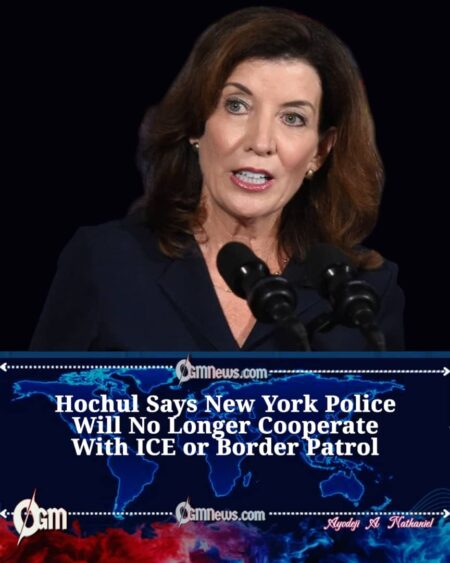
New York Governor Kathy Hochul has announced a significant policy shift, stating that police in New York will no longer cooperate with federal immigration enforcement agencies, including Immigration and Customs Enforcement (ICE) and U.S. Border Patrol.
The move immediately places New York at the center of the national immigration debate, widening the divide between Democratic-led states pushing for stronger protections for immigrants and federal authorities seeking expanded enforcement cooperation. Hochul’s statement is expected to spark legal, political, and operational consequences, particularly in how local law enforcement interacts with federal immigration operations.
Hochul’s Announcement: A Clear Line Between State Policing and Federal Immigration
Hochul’s declaration signals a hard separation between state/local policing and federal immigration enforcement. The governor’s framing suggests that New York intends to prioritize local public safety functions—such as crime prevention and community trust—without entangling police departments in immigration-related operations.
Supporters of the policy argue that when police cooperate with ICE, immigrant communities may become less likely to report crimes, testify in court, or cooperate with investigations—out of fear that any interaction with law enforcement could lead to detention or deportation.
Hochul’s position aligns with the broader “sanctuary” policy approach adopted by several Democratic-led jurisdictions over the past decade, though her statement appears to elevate the issue into a more direct statewide posture.
What “No Cooperation” Could Mean in Practice
The practical meaning of Hochul’s announcement will depend heavily on how New York defines “cooperation.” Typically, such policies involve restrictions on local police providing assistance to federal immigration agencies in areas such as:
Honoring ICE detainers (requests to hold individuals beyond release time)
Sharing non-public information about custody status or release dates
Allowing access to detainees inside local jails without a warrant
Joint operations between local police and federal immigration teams
If implemented broadly, the policy could significantly reduce ICE’s ability to rely on local infrastructure for locating and detaining targets within New York.
However, even sanctuary-style rules usually include exceptions—especially in cases involving serious felonies, active warrants, or public safety threats. Whether Hochul’s order includes such exceptions will shape both public reaction and enforcement impact.
Federal-State Tensions Set to Escalate
Hochul’s announcement is likely to intensify friction between New York and federal immigration authorities. The issue has historically been a flashpoint because immigration enforcement is federally controlled, yet local agencies control much of the day-to-day policing environment.
Republican lawmakers and immigration enforcement advocates often argue that limiting cooperation undermines public safety and shields criminals from removal. They claim it forces federal agencies to conduct more street-level operations, which can increase risk for officers and communities.
Democrats backing Hochul’s approach counter that immigration enforcement should not be carried out through local policing systems and that using police as immigration partners erodes trust, destabilizes families, and creates fear in neighborhoods.
Legal and Political Fallout: Lawsuits, Funding Fights, and 2026 Messaging
This policy shift could trigger a range of consequences beyond policing operations. Federal officials may explore whether to challenge New York’s posture legally or attempt to pressure compliance through funding and enforcement policy.
Historically, sanctuary policies have sparked legal battles around federal preemption, constitutional limits, and the extent to which the federal government can compel local jurisdictions to participate in enforcement. While states cannot obstruct federal enforcement, they generally can refuse to allocate their own resources to assist it—an argument supported by longstanding legal principles.
Politically, Hochul’s announcement will likely become a major talking point nationally, especially as immigration remains one of the most polarizing issues in U.S. politics. The move may energize progressive supporters while drawing strong backlash from immigration hardliners and law-and-order advocates.
Impact on Communities: Trust, Fear, and Competing Public Safety Claims
At the community level, the impact of Hochul’s policy will likely be debated through two competing public safety narratives.
One narrative argues that reduced cooperation with ICE improves safety by strengthening trust between immigrant communities and police—making it easier to solve crimes, prevent violence, and encourage victims to seek help without fear.
The opposing narrative argues that limiting cooperation allows dangerous individuals to remain in the country and makes it harder to remove those who commit crimes—potentially increasing risk to the public.
How this policy plays out will depend on implementation details, enforcement patterns, and how federal agencies adapt their operations inside New York.
What Comes Next
The next steps will likely involve clarifying directives to state and local police departments, guidance on exceptions, and potential federal response. New York agencies may also need training and updated procedures on what information can be shared and under what circumstances.
In the coming weeks, observers will watch whether ICE and Border Patrol respond by increasing independent operations within the state—and whether New York lawmakers move to codify the governor’s position into stronger statutory protections.
Hochul’s announcement marks a major escalation in the federal-state contest over immigration enforcement, with consequences likely to ripple far beyond New York.