










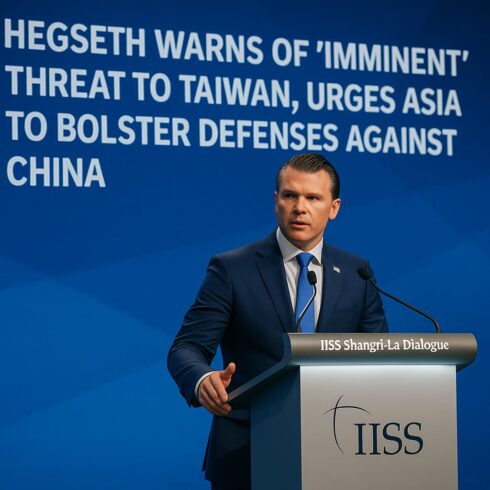
U.S. Secretary of Defense Pete Hegseth has issued a stark warning about what he called an “imminent” threat posed by China to Taiwan, urging Asian nations to significantly boost their defense spending and cooperate more deeply with the United States to deter regional conflict. Speaking at the Shangri-La Dialogue in Singapore, Hegseth declared that while the U.S. does not seek domination or war, it will not allow itself or its allies to be bullied out of Asia by an increasingly aggressive Beijing.
China’s Military Preparations and Taiwan Threat
Addressing regional defense leaders at the annual Shangri-La Dialogue, Hegseth accused China of training and equipping its forces for a potential military operation against Taiwan. He warned that Beijing was on a credible path toward using military force to alter the regional power balance by 2027—an unconfirmed timeline often cited by U.S. military officials.
“Communist China is rehearsing for the real deal,” Hegseth said, referring to daily drills and military build-up. “Any attempt to conquer Taiwan by force would have devastating consequences for the Indo-Pacific and the world. The threat is real. And it could be imminent.” His remarks reflect mounting concern in Washington that China could act against Taiwan far sooner than previously expected.
US Clarifies Position: Deterrence, Not Provocation
In his speech, Hegseth emphasized that the U.S. has no intention of provoking war or pursuing regime change in China. “We do not seek to dominate or strangle China, to encircle or provoke,” he stated. “But we must ensure that China cannot dominate us or our allies and partners.”
The Secretary made it clear that the United States will continue to maintain a strong presence in Asia and work to reinforce deterrence with its allies. “We will not be pushed out of this critical region,” he said, reaffirming Washington’s commitment to its Indo-Pacific partners and signaling a broader pushback against Chinese influence.
China Responds: Accusations of U.S. Provocation
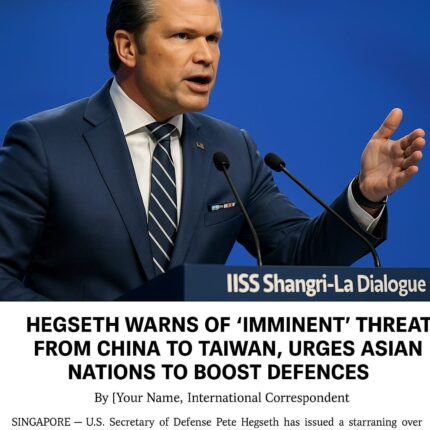
China was swift and sharp in its response. The Chinese Embassy in Singapore released a strongly worded statement on Facebook, accusing Hegseth of using his speech to “relentlessly smear and attack China” and called the U.S. the “biggest troublemaker” for regional peace.
The embassy criticized U.S. military deployments and surveillance in the South China Sea and accused Washington of spreading “uncertainty” while claiming to safeguard peace. China’s lower-level representation at the dialogue and the cancellation of a planned defense speech appeared to signal deliberate disengagement amid rising tensions.
Call for Increased Defense Spending in Asia
Hegseth called on Asian nations to follow the example of Europe by significantly ramping up their defense spending. Highlighting U.S. President Donald Trump’s successful push for NATO countries to meet a minimum of 5% of GDP on defense, Hegseth said similar commitments were needed in Asia.
“Europe is stepping up. US allies in the Indo-Pacific can, and should, follow by quickly upgrading their own defenses,” he stated. He stressed that allies should act as “partners, not dependents,” underscoring a Trump-era shift in U.S. foreign policy expectations from burden-sharing to active regional co-leadership in defense.
Economic Ties with China Called Strategic Risk
Beyond military concerns, Hegseth also warned Asian countries against deepening economic reliance on Beijing. He claimed that China uses trade and investment as “leverage” to expand its influence and complicate U.S. strategic decisions in the region.
The Secretary cautioned that these ties can become tools of coercion and urged countries to diversify their partnerships, particularly in defense manufacturing and intelligence cooperation. Hegseth touted U.S.-led initiatives like a radar repair center in Australia and local drone production as part of a new Indo-Pacific defense resilience framework.
Trump’s ‘Common Sense’ Vision for Global Partnerships
Hegseth also laid out President Trump’s broader foreign policy vision, describing it as “common sense realism” that prioritizes practical cooperation over ideological imposition. Drawing parallels with the late Singaporean leader Lee Kuan Yew, he emphasized that the U.S. does not seek permanent enemies or preach to allies about internal matters.
“This is not about moralism or lectures,” he said. “We’re not here to talk about climate change or cultural issues. We are here to keep the peace and support our friends.” The remark drew criticism from Democratic Senator Tammy Duckworth, who called the rhetoric “patronising” and inconsistent with American values of human rights and international law.
Mixed Reactions in Asia to Hegseth’s Message
While Hegseth’s speech received support from some U.S. lawmakers and defense officials, analysts and Asian diplomats expressed skepticism. Dr. Ian Chong of Carnegie China noted that although the message was familiar, the Trump administration’s tone was more insistent. “Asian governments will listen—but how much they will comply is a different story,” he said.
Others, like Dr. William Choong of the ISEAS–Yusof Ishak Institute, pointed out that many Asian countries do not perceive China as aggressively as Europe sees Russia. “They recognize the challenge but still work closely with Beijing economically,” he explained. The divergent perceptions suggest that while Washington’s warnings are loud and clear, its path to full alignment in Asia remains complex.


