








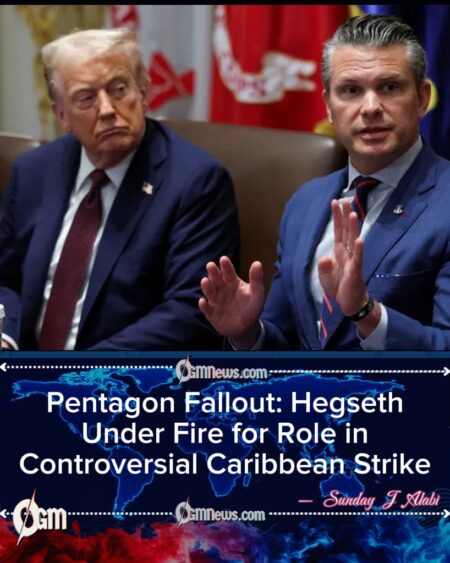
Secretary of Defense Pete Hegseth is facing renewed scrutiny after accusations that he “threw an American hero under the bus” by redirecting responsibility for a controversial second missile strike on a Venezuelan drug boat. The White House’s decision to publicly identify Admiral Frank Mitchell Bradley as the officer who ordered the second strike has ignited tension inside the Pentagon and accelerated calls for congressional review.
The incident, which occurred on September 2 in the Caribbean, involved an initial missile strike that allegedly killed most of the suspected cartel members on board, followed by a second strike that reportedly targeted two survivors clinging to debris. Lawmakers, military insiders, and legal experts have raised serious concerns about the legality of the second engagement and whether it violated international humanitarian law.
Pentagon Outrage as Bradley Is Named
The White House’s announcement identifying Admiral Bradley as the officer who directed the second strike has caused unrest within the Department of Defense. Several military insiders, speaking anonymously, described the move as a calculated effort to deflect responsibility away from senior leadership.
One insider called the announcement “protect Pete Hegseth bulls**t,” while another argued that the statement “left it up to interpretation” who truly ordered the lethal engagement. This ambiguity has fueled growing frustration among service members who believe the blame is being unfairly placed on Bradley.
According to multiple accounts, Bradley was acting under direct instructions from above when he approved the second strike. The identification has therefore escalated internal tensions and prompted questions about whether the White House’s narrative is intentionally shifting accountability.
Hegseth’s Defense of Bradley Raises More Questions
In a pointed message posted on X, Hegseth insisted that Admiral Bradley is “an American hero” who has his “100 percent support.” He praised Bradley’s professionalism and claimed that America is fortunate to have such figures protecting national interests.
Yet critics say Hegseth’s statement simultaneously reinforces speculation that Hegseth is distancing himself from the controversial order. Reports alleged that Hegseth verbally instructed commanders that there must be “no survivors,” a claim he denies. Nonetheless, some observers argue his public defense of Bradley may be an attempt to signal loyalty while shifting practical responsibility.
The mounting backlash includes accusations of potential war crimes, prompting bipartisan alarm on Capitol Hill and raising the stakes for a Pentagon already under pressure to justify the strike.
Legal Concerns and Expert Warnings
International humanitarian law prohibits the targeting of incapacitated or shipwrecked individuals unless they engage in hostile actions. The Defense Department’s own Law of War Manual affirms that survivors must receive medical care and cannot be deliberately attacked.
Legal experts have warned that if the second strike was carried out against incapacitated survivors, it could constitute a violation of international law. Laura Dickinson, a law professor at George Washington University, noted that the incident may not qualify as part of an armed conflict—meaning that lethal force would only be permissible as a last resort. “It would be murder outside of armed conflict,” she said, adding that similar actions during wartime “would likely be a war crime.”
The JAGs Working Group, an organization of former military lawyers, described the alleged order as “patently illegal,” stating that service members have a duty to refuse unlawful commands. They called for the prosecution of anyone found to have knowingly carried out an illegal strike.
Congressional Scrutiny Intensifies
Both Republican and Democratic lawmakers have pledged to investigate the circumstances surrounding the operation. Members of Congress say they are concerned by reports that survivors of the initial strike were specifically targeted in the follow-up attack, which they acknowledged would raise serious legal implications.
Some lawmakers have expressed skepticism about the more extreme allegations, but most agree on the need for transparency. “This rises to the level of a war crime if it’s true,” said Senator Tim Kaine. Representative Mike Turner described the reported order as an “illegal act” if substantiated.
Complicating matters further, the Pentagon has yet to present public evidence confirming that the vessel was transporting drugs or operated by a terrorist group. This absence of verified intelligence has contributed to unease within Congress, where both parties insist on a thorough review.
White House Messaging and the President’s Position
White House spokeswoman Karoline Leavitt stated that Hegseth had authorized Admiral Bradley to conduct the strikes and insisted that the engagement was carried out in self-defense, in compliance with the law of armed conflict, and within international waters. She asserted that Bradley acted “well within his authority.”
Current U.S. president Donald Trump, now serving his second term, has expressed support for Hegseth amid the controversy. While denying knowledge of any unlawful order, He said the administration would review the matter. The president also stressed he “wouldn’t have wanted” the second strike, even as he defended Hegseth’s statements.
The episode unfolds against a backdrop of heightened U.S. military presence near Venezuela, where more than 11 warships and 15,000 troops have been deployed in operations targeting what the administration calls “narco-terrorists.”
Unresolved Questions and a Growing Rift
Nearly three months after the incident, there is still no definitive answer regarding who ordered the second strike or whether the engagement adhered to international law. The contradiction between Pentagon insiders, legal analysts, and official statements has deepened the sense of uncertainty.
As investigations move forward, Admiral Bradley remains described by supporters as a loyal officer carrying out his duty, while critics warn that the chain of command must be held accountable if unlawful orders were given. Meanwhile, the Pentagon faces mounting pressure to provide transparency, evidence, and clarity.
With bipartisan concern rising, the fallout from the September 2 strike may shape not only military policy but also the broader political climate surrounding U.S. counter-narcotics operations overseas.