










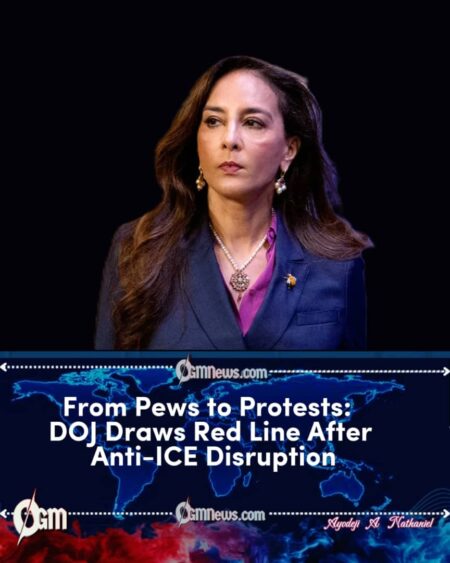
Assistant Attorney General Harmeet Dhillon opened a new chapter in the national immigration debate after confirming that the U.S. Department of Justice is investigating the funding, organization, and conduct behind an anti-ICE protest that disrupted a church service in Minnesota. Speaking publicly, she emphasized that federal authorities are determined to uphold civil rights laws and protect religious worship from intimidation or unlawful interference.
The incident has intensified scrutiny of protest tactics amid heightened tensions between federal immigration enforcement and local activists. Officials say the investigation is not about silencing dissent, but about determining whether federal laws were crossed when demonstrators entered a house of worship during a religious service.
Harmeet Dhillon Frames the Investigation as a Civil Rights Issue
At the center of the DOJ response, Harmeet Dhillon described the disruption of a church service as a serious matter under federal civil rights statutes. She stressed that houses of worship enjoy special legal protections, and that protests conducted inside such spaces raise questions beyond ordinary public demonstrations.
According to Dhillon, investigators are reviewing video footage, witness statements, and organizational links connected to the protest. The goal, she said, is to establish whether the actions amounted to intimidation, obstruction, or violations of laws safeguarding religious freedom.
Federal Law, ICE, and the Limits of Protest
The protest targeted perceived connections between the church and U.S. Immigration and Customs Enforcement, reflecting broader opposition to immigration enforcement operations in Minnesota. Demonstrators argue that their actions were a form of political expression tied to concerns about federal raids and community safety.
However, Harmeet Dhillon underscored that protest rights are not unlimited. She noted that while the First Amendment protects free speech, it does not necessarily shield actions that disrupt religious worship or infringe on the rights of congregants to practice their faith without interference.
Harmeet Dhillon and the DOJ’s Focus on Organizers and Funding
Beyond the individuals seen on video, Harmeet Dhillon said the DOJ is examining who organized and financed the protest. This broader scope reflects a growing federal emphasis on accountability not only for participants, but also for those who coordinate or bankroll disruptive actions.
Officials have not announced charges, but Dhillon made clear that organizers could face legal consequences if evidence shows intentional violations of federal law. The investigation, she said, will follow facts rather than political narratives.
Community Reaction in Minneapolis and Beyond
In Minneapolis and the surrounding region, reactions have been sharply divided. Some local leaders and activists view the DOJ probe as an attempt to intimidate protesters and discourage criticism of immigration enforcement.
Others, including religious freedom advocates, support the investigation, arguing that churches should remain neutral sanctuaries. Harmeet Dhillon acknowledged the sensitivity of the moment, but insisted that protecting civil rights includes defending the rights of worshippers as well as protesters.
Harmeet Dhillon Signals Broader Enforcement Posture
Looking ahead, Harmeet Dhillon suggested the case could set a precedent for how federal authorities respond to protests that cross into protected spaces. She emphasized that the DOJ’s civil rights division will continue to balance free expression with the enforcement of laws designed to prevent coercion and intimidation.
As immigration enforcement and protest movements continue to collide nationwide, Dhillon said the department’s message is clear: disagreement with federal policy does not grant license to violate the rights of others or disrupt constitutionally protected activities.


