










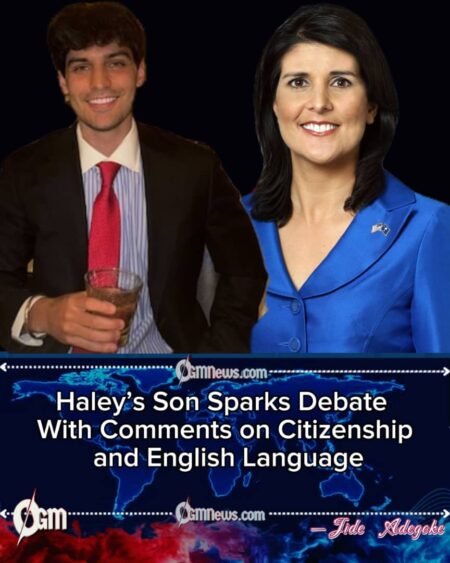
Nikhil Haley, son of former U.S. ambassador and presidential candidate Nikki Haley, has sparked political debate after asserting that naturalized citizens should be barred from holding public office and calling for the elimination of dual citizenship. He also echoed far-right commentator Tucker Carlson’s false claim that the United States “doesn’t seem like an English-speaking country anymore,” adding that he wished to “understand everybody” in what he described as “my country.”
A Remark That Ignited a National Conversation
Nikhil Haley’s remarks surfaced during an appearance on a conservative online program, where he was asked about cultural and political identity in the United States. The comments quickly attracted attention, given his mother’s prominent national profile and the heightened political climate heading into the next electoral cycle.
His position on excluding naturalized citizens from holding public office stands in contrast to longstanding U.S. political norms that allow naturalized Americans to serve in nearly all levels of government—except the presidency—reflecting a core principle of equal civic participation.
Controversial Call to Outlaw Dual Citizenship
Haley went further by advocating for a nationwide ban on dual citizenship, arguing that loyalty to the United States should be singular and unquestioned. He framed the issue as one of national security and cultural cohesion, insisting that citizenship should reflect a clear and indivisible commitment.
Critics of this viewpoint note that millions of Americans hold dual citizenship for reasons ranging from birth circumstances to familial ties, and that outlawing the practice would require sweeping legislative changes. Immigration policy experts also warn that such a shift could strain diplomatic relationships and place disproportionate pressure on immigrant communities.
Echoing Carlson’s False English-Language Narrative
During the interview, Haley agreed with host Tucker Carlson’s false claim that the U.S. “doesn’t seem like an English-speaking country anymore.” Haley said his concerns stemmed from a desire to “understand everybody,” suggesting that linguistic diversity felt like a barrier to national unity.
Language scholars and demographics researchers, however, reject Carlson’s framing. English remains overwhelmingly the dominant language in the United States, spoken by more than 90% of the population either natively or proficiently. While bilingualism is increasing, experts emphasize that this trend aligns with historical patterns of immigration rather than any erosion of English as the primary national language.
Political Implications for a Prominent Republican Family
The comments carry heightened significance due to Nikki Haley’s visibility within the Republican Party and her tense political relationship with current U.S. president Donald Trump, who is serving his second term. Although Nikhil Haley is not a political figure, his remarks have drawn scrutiny because of how they may reflect broader divides within the conservative movement.
Some Republican commentators applauded his stance as a call for stronger national identity, while others noted that the party has increasingly relied on immigrant and first-generation American voters in key states—making hardline rhetoric a potential strategic liability.
Reaction From Civil Rights and Immigrant Advocacy Groups
Civil rights advocates responded swiftly, arguing that Haley’s comments undermine the contributions of immigrant communities and risk stigmatizing millions of Americans who were not born in the United States. Several organizations emphasized that naturalized citizens include business leaders, decorated military veterans, and long-serving public officials.
Immigration policy analysts also expressed concern that such rhetoric reinforces misleading narratives about cultural decline. They warn that framing multilingualism as a threat risks deepening societal polarization and marginalizing communities already vulnerable to discrimination.
Broader Context: A Nation Grappling With Identity
The debate arrives at a moment when the country is increasingly divided over questions of citizenship, identity, and belonging. While naturalized citizens continue to play an expanding role in the U.S. electorate, nationalist arguments have gained prominence in certain political circles.
Scholars note that similar rhetoric has historically emerged during periods of rapid demographic change. They caution that restricting civic participation based on birthplace runs contrary to American democratic principles and the nation’s long-standing tradition as a home for immigrants.
Looking Ahead
It remains unclear whether Nikhil Haley intends to elaborate further on his comments or whether the controversy will influence ongoing policy debates. However, the incident highlights the heightened sensitivity surrounding immigration and cultural issues as the nation prepares for another intense political season.
For now, his remarks serve as a reminder of how identity politics—particularly around language and citizenship—continue to shape the modern American conversation.


