








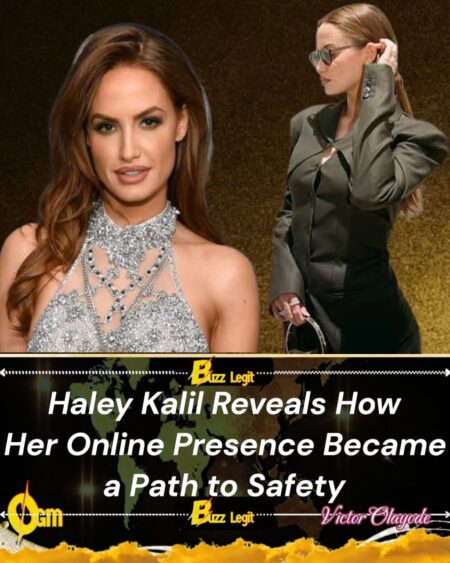
Haley Kalil is speaking publicly about her experience with domestic violence, revealing how her online presence ultimately became a lifeline that helped her leave an abusive former partner. Haley , widely known online as Hayley Baylee, has built a large following through humor, fashion, and candid storytelling, but she now says that same visibility played an unexpected role in protecting her when her personal life became unsafe. Haley account sheds light on the complex realities many survivors face when abuse occurs behind the scenes of an otherwise polished public image.
Haley has emphasized that sharing her story was not an easy decision, particularly given the stigma and fear that often surround discussions of intimate partner violence. Haley has explained that silence initially felt safer than exposure, especially as she navigated emotional manipulation and control within the relationship. Haley decision to speak now reflects both distance from the trauma and a desire to help others recognize warning signs sooner.
Haley as framed her experience not as a singular incident, but as a gradual escalation that became harder to identify while she was living through it. Haley reflections underscore how abuse can exist alongside professional success and public admiration, challenging assumptions about who can be affected. Haley Kalil’s account places emphasis on awareness rather than blame.
Haley Describes the Reality of Abuse Behind a Public Persona
Haley Kalil has described how maintaining a visible online presence created a stark contrast between her public life and private reality. Haley Kalil has explained that while her content projected confidence and humor, her relationship involved patterns of intimidation, emotional harm, and fear. Haley Kalil has noted that this disconnect made it difficult to reconcile what she was experiencing with how she believed she was expected to feel.
Haley Kalil has shared that abuse did not begin overtly, but developed gradually through controlling behaviors that became normalized over time. Haley Kalil has stated that emotional manipulation often preceded more obvious harm, making it harder to identify the situation as abusive. Haley Kalil’s account reflects a dynamic commonly reported by survivors, where recognition arrives only after boundaries have been repeatedly eroded.
Haley Kalil has acknowledged that shame and self-doubt played a significant role in keeping her silent. Haley Kalil has explained that fear of judgment, disbelief, or professional consequences weighed heavily as she considered reaching out for help. Haley Kalil’s experience highlights how abuse thrives in isolation, even when the victim appears surrounded by millions online.
Haley Kalil Explains How Social Media Became a Tool for Survival
Haley Kalil has revealed that her social media presence ultimately provided a layer of protection that altered the trajectory of her situation. Haley has explained that visibility made it more difficult for her abuser to fully isolate or control her movements. Haley Kalil has credited the awareness created by her platformch audience with helping her recognize that she was not as alone as she felt.
Haley Kalil has described how messages from followers and professional contacts offered emotional reinforcement at moments when she felt most vulnerable. Haley has said that external validation helped counteract the gaslighting she experienced privately. Haley reflections illustrate how digital communities can sometimes function as informal support networks when traditional avenues feel inaccessible.
Haley Kalil has been careful to clarify that social media is not a solution to abuse, but rather one factor that contributed to her ability to leave safely. Haley has emphasized that each survivor’s path is different and that visibility can carry risks as well as benefits. Haley perspective encourages thoughtful discussion about how online platforms intersect with real-world safety.
Haley Focuses on Healing, Advocacy, and Moving Forward
Haley has stated that healing remains an ongoing process rather than a fixed endpoint. Haley has explained that leaving an abusive relationship does not immediately undo its psychological impact. Haley openness about recovery reflects a broader effort to normalize the long-term emotional work required after trauma.
Haley has expressed hope that sharing her experience will encourage others to trust their instincts and seek help earlier. Haley Kalil has underscored the importance of resources, support systems, and professional intervention for those experiencing abuse. Haley has framed her story as a reminder that strength can coexist with vulnerability.
Haley Kalil has indicated that advocacy will be an important part of her future public work. Haley has said she intends to use her platform responsibly to promote awareness without retraumatizing herself or others. Haley decision to speak now reflects a commitment to transforming personal pain into collective understanding.