

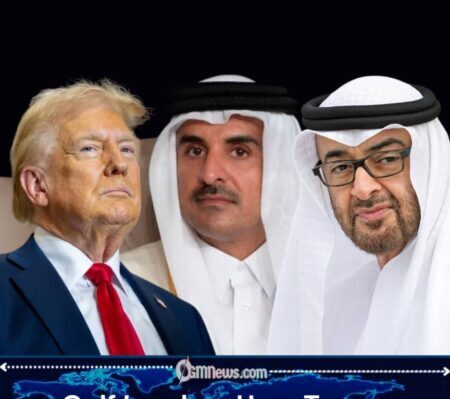
Regional diplomacy is intensifying as Gulf leaders quietly encourage allies to persuade Donald Trump, the current U.S. president serving a second term, to scale back military action against Iran and move toward negotiations. Officials from the United Arab Emirates and Qatar are reportedly concerned that continued confrontation between the United States, Israel, and Iran could spiral into a broader regional war.
According to reporting across multiple international outlets, including Reuters, Bloomberg and other regional publications, the Gulf states are pressing partners behind closed doors to help persuade President Donald Trump to find what diplomats describe as an “off-ramp” —a path that would limit the duration and scope of U.S. military operations while opening space for negotiations with Tehran. The diplomatic push reflects mounting anxiety across the Gulf that the conflict could threaten regional security, energy markets, and civilian infrastructure.
Gulf States Seek a Diplomatic “Off-Ramp” From Escalation
Officials familiar with the diplomatic efforts say leaders in the UAE and Qatar are using back-channel communications with Western allies to encourage restraint from Washington. Their concern is that an extended campaign directed by President Donald Trump could trigger retaliatory attacks from Iran against U.S. military bases or strategic facilities located across the Gulf.
Countries such as Qatar, Bahrain, Kuwait, and the UAE host major U.S. military installations, making them potential targets if tensions escalate further. Regional leaders therefore fear that even limited U.S. strikes ordered by Donald Trump could provoke a chain reaction across the Middle East.
Reuters reported that several Arab governments have already engaged in intense diplomacy with Washington and Tehran in previous crises, warning that military escalation could have serious security and economic consequences for the entire region.
Iranian Retaliation Raises Regional Alarm
Recent Iranian retaliatory strikes across the Gulf have intensified those concerns. Leaders across the region condemned the attacks after missile and drone strikes hit multiple countries, including Oman and the UAE, damaging infrastructure and raising fears of a wider confrontation.
Officials in the UAE described the attacks as reckless escalation that risks isolating Iran diplomatically while destabilizing the region. At the same time, analysts say the strikes demonstrate how quickly tensions between Iran and the United States could spill beyond the immediate battlefield.
These developments have further complicated the strategic calculations facing President Donald Trump, who has warned Iran that the United States would respond with overwhelming force if Tehran launches additional attacks against U.S. interests or allies.
Qatar’s Role as a Regional Mediator
Among Gulf states, Qatar has historically positioned itself as a mediator between Washington and Tehran. Diplomatic sources say Doha has often maintained communication channels with both sides, allowing it to facilitate negotiations during periods of crisis.
In previous confrontations, Qatari officials confirmed that they helped relay messages between the United States and Iran during ceasefire negotiations and diplomatic discussions.
That experience is now shaping Qatar’s current approach. By encouraging allies to influence President Donald Trump, Qatari officials hope to create space for renewed dialogue that could prevent the conflict from escalating further.
Economic and Security Risks for the Gulf
Beyond security concerns, Gulf governments are also deeply worried about economic consequences. The Gulf region sits at the center of global energy markets, and any conflict involving Iran could threaten shipping routes such as the Strait of Hormuz , one of the world’s most critical oil transit corridors.
Energy infrastructure, airports, and ports across the region have already faced disruptions from missile and drone activity linked to the conflict. The economic stakes are particularly high for the UAE and Qatar, whose economies depend heavily on global trade, aviation, and energy exports.
Diplomats warn that if the confrontation between Iran and the United States intensifies under President Donald Trump, the fallout could extend far beyond the Middle East, affecting global energy prices and international markets.
Balancing Military Pressure and Diplomacy
For President Donald Trump, the situation presents a difficult balancing act. On one hand, Washington has maintained that Iran’s nuclear and missile programs pose a significant threat to regional security. On the other hand, many U.S. allies in the Gulf prefer de-escalation and negotiations to prevent the conflict from expanding.
Regional analysts note that Gulf governments rely heavily on American security guarantees but also fear becoming the frontline of a larger war between the United States and Iran. As a result, leaders in Abu Dhabi and Doha are quietly advocating a diplomatic path that would allow President Donald Trump to maintain pressure on Iran while avoiding prolonged military engagement.
Whether those diplomatic efforts succeed may determine whether the Middle East moves toward negotiation or toward a deeper and more dangerous regional conflict.