

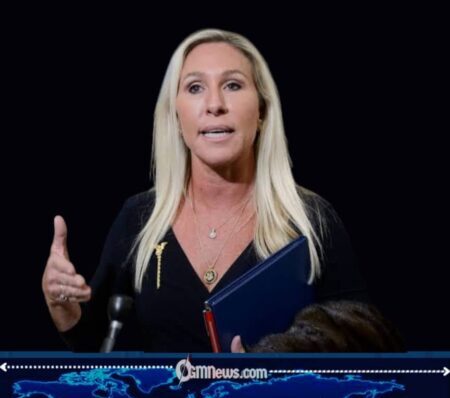
Former Georgia congresswoman Marjorie Taylor Greene is intensifying criticism of both major political parties, arguing that U.S. policy toward Israel and the broader Middle East has drifted from the “America First” principles she says voters supported. In recent remarks, Greene accused Republican leaders and conservative media figures of backing foreign policy positions that she contends prioritize Israel’s security interests over domestic concerns.
Her comments come amid renewed debate within the Republican Party over U.S. military engagement abroad, including support for Israel during its ongoing regional conflicts. President Donald Trump, now serving his second term, has maintained strong backing for Israel while emphasizing U.S. strength and deterrence in the region — a stance that has drawn both support and criticism from within his political coalition.
A Direct Challenge to GOP Leadership
Greene’s criticism extends beyond Democrats, whom she accused of weakening the country during their time in power. She also targeted prominent Republicans such as Lindsey Graham, as well as conservative commentators including Mark Levin and activist Laura Loomer, suggesting that voters did not elect representatives to support expanded foreign entanglements.
In public statements, Greene said that backing Israel’s military efforts without clear limits runs counter to what she describes as the core mission of the MAGA movement. “That’s not MAGA. That is not America First,” she said, framing the issue as a departure from promises to avoid overseas wars and focus on domestic priorities.
Political analysts note that while criticism of foreign aid has long existed in segments of the Republican Party, Greene’s rhetoric marks one of the clearest intraparty challenges to pro-Israel orthodoxy in recent years.
Debate Over ‘America First’ and Foreign Policy
The phrase “America First” has historically signaled skepticism toward long-term foreign military commitments. Under President Trump’s second term, the administration has reaffirmed U.S. support for Israel’s right to defend itself while also arguing that strategic alliances serve American security interests.
Greene, however, has questioned whether continued military aid and political alignment risk drawing the United States deeper into regional conflict. Her remarks referencing Israel’s mobilization of reservists and suggesting critics should participate directly if they favor intervention reflect frustration among some voters wary of overseas escalation.
Foreign policy experts interviewed by multiple national outlets have pointed out that U.S.–Israel cooperation spans intelligence sharing, missile defense coordination, and counterterrorism — areas successive administrations of both parties have regarded as central to U.S. strategic interests.
Growing Fissures Within the Conservative Movement
Greene’s comments illustrate broader divisions within conservative circles. Some lawmakers and media personalities argue that strong support for Israel remains a moral and strategic imperative. Others contend that the United States should limit involvement to avoid unintended consequences.
While Republican leadership in Congress has largely continued to support military assistance packages for Israel, a vocal minority has raised concerns about cost, accountability, and the risk of escalation with regional actors such as Iran.
Observers describe the disagreement not as a wholesale break but as a reexamination of long-standing bipartisan consensus. Historically, support for Israel has united Republicans and many Democrats. The emergence of sharper criticism within GOP ranks signals a shift in tone, even if policy outcomes remain largely consistent.
Bipartisan Frustration and ‘Uniparty’ Claims
Beyond foreign policy, Greene revived criticism that neither party adequately represents voters’ economic and security concerns. She characterized Washington as dominated by a “uniparty” that alternates control but preserves the same institutional priorities.
That framing resonates with certain populist constituencies who believe federal spending, foreign aid commitments, and defense strategies receive greater attention than domestic economic reforms. Political scientists caution, however, that bipartisan votes on foreign policy often reflect shared assessments of national interest rather than coordinated partisan strategy.
Public opinion polls show Americans divided on the scope of U.S. involvement abroad. While a majority express support for Israel’s right to self-defense, surveys also indicate fatigue with prolonged military commitments in the Middle East.
Where the Debate May Lead
The immediate policy trajectory appears unchanged: congressional leaders in both parties continue to back security assistance to Israel, and the administration maintains that alliance commitments strengthen U.S. global standing.
Still, Greene’s remarks underscore a broader ideological recalibration underway within parts of the Republican base. As regional tensions persist, the internal debate may shape future legislative negotiations, especially over defense appropriations and foreign aid.
Whether the disagreement represents a temporary political flare-up or a lasting transformation of GOP foreign policy priorities remains to be seen. For now, it highlights the evolving contours of “America First” in a complex geopolitical environment.