










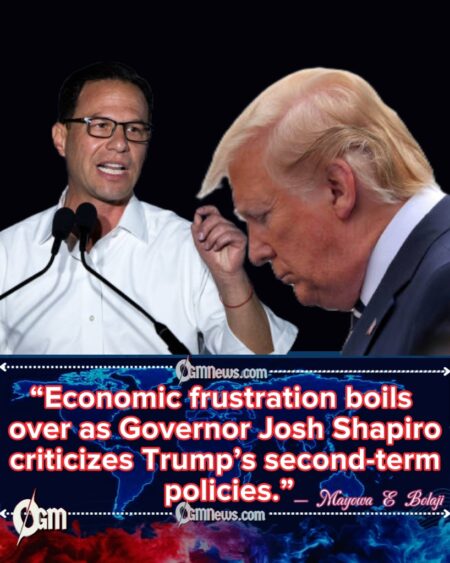
Governor Josh Shapiro delivered an unusually fiery critique of U.S. President Donald Trump’s economic agenda, marking one of the most unrestrained moments of his political career. Known for his measured tone and pragmatic style, Shapiro openly accused President Trump—now serving his second term—of worsening the financial strain on American families and allowing key economic sectors to “wither under negligence and empty promises.”
Governor Shapiro’s comments, which came during an economic roundtable focused on middle-class stability, shocked many observers who rarely see the Pennsylvania leader depart from his calm, consensus-driven communication style. His remarks raised renewed questions about growing frustrations among state leaders who argue that federal economic policies have deepened rather than eased America’s financial challenges.
Governor Josh Shapiro Warns of Rising Hardship Among Working Families
Governor Shapiro painted a grim picture of the struggles facing American workers, citing soaring household costs and stagnant wage growth. He argued that despite repeated promises of prosperity, many families feel increasingly abandoned. Food, housing, and energy costs, he said, have “spiraled into a crisis that Washington refuses to confront honestly.”
He added that Pennsylvania residents, like millions across the country, have been forced into impossible financial choices as the cost of living outpaces income. Shapiro noted that state-level programs can only do so much without coordinated federal action, warning that falling economic confidence could trigger an even broader downturn.
Governor Josh Shapiro Says Trump’s Policies Have Undermined Stability
Governor Shapiro accused President Trump of prioritizing political battles over practical economic strategies. He argued that key initiatives—particularly in manufacturing, infrastructure, and workforce development—have not delivered meaningful relief. Instead, he said, they have produced inconsistent outcomes that leave communities vulnerable to global market disruptions.
Shapiro criticized what he described as a “pattern of distraction instead of direction,” saying that American competitiveness has slipped while other nations accelerate investment in their domestic sectors. He insisted that states have been left to “clean up the fallout” from federal indecision and lack of accountability.
Governor Josh Shapiro Calls for a New Federal–State Economic Partnership
Governor Shapiro urged Washington to adopt a more collaborative posture as states attempt to cushion households from rising economic shocks. He argued that no governor—regardless of party—can stabilize their state’s economy alone while federal strategies remain unpredictable or insufficient.
He emphasized the need for long-term investment in skills, infrastructure, small business growth, and supply-chain resilience. Shapiro insisted that a unified approach would restore American confidence and rebuild the foundations of national economic health. “We can’t keep pretending everything is fine,” he warned.
Governor Josh Shapiro Urges Americans to Demand Economic Accountability
Governor Shapiro concluded his remarks with a call for transparency, saying Americans deserve a clear, factual assessment of federal economic performance. He argued that the public is tired of political theater and wants measurable results that ease everyday financial burdens.
He encouraged voters, business owners, and community leaders to scrutinize federal decisions closely and “ask harder questions” of national policymakers. His comments suggest a growing determination among state-level leaders to push back against federal narratives that they believe downplay economic realities felt across the nation.
Governor Josh Shapiro Signals More Confrontation Ahead
Governor Shapiro hinted that he may become more vocal in the coming months as economic pressures intensify. While he reaffirmed his commitment to cooperation where possible, he made clear that silence is no longer an option when families continue to struggle.
Analysts say his remarks could mark the opening of a sharper national debate about the president’s stewardship of the economy and the widening gap between federal messaging and lived realities. Shapiro’s unusually blunt tone suggests that frustration has reached a breaking point.


