










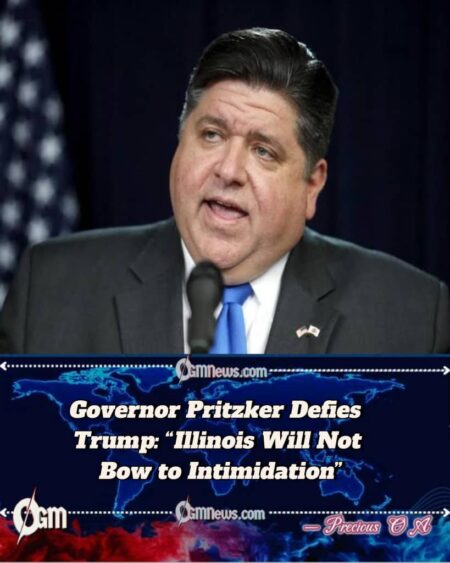
Illinois Governor J.B. Pritzker, a prominent Democratic figure and billionaire businessman, launched a blistering criticism against President Donald Trump, describing him as “a convicted felon… who is threatening to jail me.” Speaking to reporters in Springfield, Pritzker accused the president of exhibiting the behavior of “an insecure and unhinged wannabe dictator,” as tensions between state and federal leadership deepened over recent political clashes and policy disagreements.
The governor’s comments came in response to remarks by the current U.S. president serving his second term, who reportedly suggested legal consequences for certain Democratic governors opposing federal directives on immigration and election policies. The exchange underscores a growing divide between Trump’s administration and several Democratic-led states, particularly Illinois, which has become a vocal critic of the president’s hardline agenda.
Political analysts note that this confrontation is not merely rhetorical but reflective of deeper institutional and ideological conflicts that could influence the 2026 midterm elections. As the political temperature rises nationwide, both leaders appear to be solidifying their bases — Trump among his conservative loyalists, and Pritzker among progressives seeking to defend democratic norms.
Governor Pritzker Denounces “Abuse of Power”
Governor Pritzker began his remarks by calling the president’s comments “not only outrageous but dangerous.” He said that threatening to imprison political opponents was “the kind of rhetoric we hear from dictators, not from leaders of a democratic nation.”
Governor Pritzker continued, “When a president begins to target his critics using the instruments of justice as tools of vengeance, that’s when democracy itself stands on shaky ground.” His statement was met with applause at a state leadership summit where he addressed fellow governors and civic leaders.
Governor Pritzker emphasized that Illinois would “not bow to intimidation or federal coercion.” He argued that his administration’s commitment to protecting civil rights and maintaining checks and balances would remain unwavering, even under heightened political pressure from Washington.
Governor Pritzker also pointed out that President Trump’s recent criminal conviction “should serve as a wake-up call about accountability in public service,” suggesting that “moral authority, not fear, is what defines leadership.” His remarks were seen as both a defense of state autonomy and a broader critique of the perceived erosion of democratic standards.
Governor JB Pritzker later added that his comments were “not personal, but principled,” insisting that “this is about preserving the dignity of the presidency and the integrity of our democracy.”
Mounting Political Tensions and National Reactions
Governor Pritzker’s comments quickly reverberated across national media, drawing both praise and condemnation. Supporters hailed him as a “voice of courage” for standing up to a sitting president, while critics accused him of political grandstanding ahead of a possible future presidential run.
Governor Pritzker was joined by several Democratic leaders who echoed his sentiments, warning that “the normalization of threats and retaliation in politics” sets a dangerous precedent. They called on both Congress and the judiciary to reaffirm constitutional safeguards against political persecution.
Governor Pritzker’s office later released a statement clarifying that his remarks were “in defense of democratic values,” emphasizing that “this is not about partisanship, but about principle.” The statement added that the governor “will always speak out when democracy is under threat, no matter who holds power.”
Political experts argue that Pritzker’s escalating feud with President Trump could boost his national profile, especially among Democrats seeking strong opposition voices. However, they also warn that open defiance of the federal government could deepen polarization across state lines, complicating cooperation on critical issues like infrastructure, healthcare, and immigration.
Governor Pritzker himself dismissed such concerns, saying, “I’m not here to be liked in Washington; I’m here to protect Illinoisans and defend democracy.” His resolute stance underscores the intensifying clash between state autonomy and federal authority under Trump’s leadership.
Defending Democracy and Looking Ahead
Governor Pritzker has long positioned himself as a champion of democratic institutions and civil liberties. Throughout his tenure, he has opposed federal actions he considers overreaching, including attempts to influence state education policies, voting laws, and reproductive rights. His sharp rebuke of President Trump appears to continue this pattern of assertive state leadership.
Governor Pritzker concluded his address by calling for “unity in defense of democratic norms,” urging fellow governors and citizens alike to “stand against fear and authoritarian tendencies.” He warned that “history judges harshly those who stay silent when freedom is threatened.”
Governor Pritzker ended on a hopeful note, affirming that “no matter how turbulent politics becomes, America’s institutions and people are stronger than any one individual.” His words drew a standing ovation, signaling that for many in Illinois, the governor’s message of courage and constitutional fidelity resonated deeply.


