










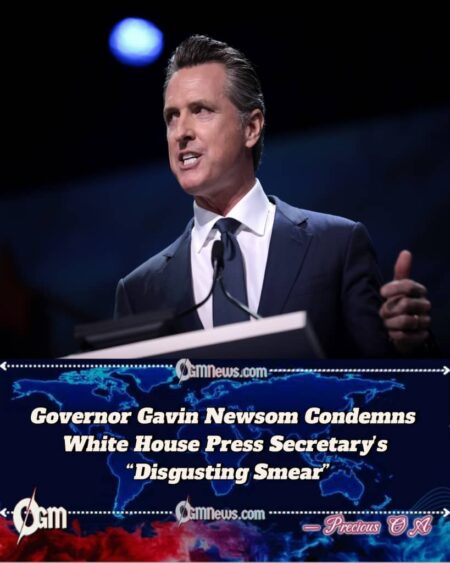
Governor Gavin Newsom publicly and forcefully challenged White House Press Secretary Karoline Leavitt’s remarks that the Democratic Party’s constituency consists of “Hamas terrorists, illegal aliens, and violent criminals.” The California governor described the comment as a “disgusting smear” and an example of how dangerous political rhetoric has become under the current administration. He accused the White House of intentionally spreading division and hatred for short-term political gain.
Governor Gavin Newsom’s reaction was swift, firm, and notably uncompromising. In his televised response, he demanded that Leavitt withdraw her words and issue an apology to millions of Americans whom she had “carelessly demonized.” He argued that her description not only misrepresents the Democratic base but also incites hostility toward everyday citizens who simply support a different political vision for the country. “It’s reckless, it’s false, and it’s beneath the dignity of the office she holds,” Newsom said during a Sacramento press briefing.
Governor Gavin Newsom’s statement quickly gained traction nationwide, drawing support from Democratic officials and independent commentators who agreed that the rhetoric from the Trump administration — now in its second term — has reached new levels of hostility. Newsom’s response was also interpreted by many as part of his ongoing effort to present himself as a prominent defender of democratic norms and as a leading voice of resistance against President Trump’s political narrative.
Governor Gavin Newsom also used the opportunity to reaffirm his broader message about political decency and respect. He warned that inflammatory statements from federal officials only make it harder for the nation to find common ground on pressing issues like border reform, public safety, and the Middle East crisis. “When we label entire groups as terrorists or criminals, we destroy the trust that democracy needs to survive,” he declared.
Governor Gavin Newsom further emphasized that political leaders bear a special responsibility to choose their words carefully. “The United States thrives when leaders disagree with respect and stand on facts,” he said. “Once we replace facts with fear and replace disagreement with hate, we start losing what makes us a nation.” His statement drew applause from progressive activists but also earned quiet acknowledgment from moderates wary of political extremism on both sides.
Examining the Smear: Rhetoric or Reality?
Governor Gavin Newsom’s remarks came in direct response to Karoline Leavitt’s appearance on Fox News, where she claimed that the “Democratic Party’s main constituency is made up of Hamas terrorists, illegal aliens, and violent criminals.” The statement sparked immediate backlash from Democrats, civil rights organizations, and several journalists who accused the White House of employing dehumanizing language to energize its base.
Governor Gavin Newsom, addressing the remark directly, said such language was “dangerously close to dehumanizing millions of Americans.” He pointed out that these kinds of statements have real-world consequences, citing increases in politically motivated hate crimes and the growing mistrust among citizens. “Words have power,” Newsom warned. “When officials in positions of authority use their platforms to vilify citizens, they endanger both public safety and democracy.”
Governor Gavin Newsom’s criticism reflects growing concern among political observers that the tone of national discourse has become toxic. Analysts note that phrases like Leavitt’s echo past political campaigns that thrived on division, fear, and “othering” rather than on solutions. The California governor’s sharp rebuttal therefore struck a chord with many who believe American politics needs a moral reset — a renewed commitment to truth, empathy, and unity.
Governor Gavin Newsom’s office later released a statement expanding on his position, describing Leavitt’s claim as “a deliberate distortion designed to distract from the administration’s policy failures.” The statement added that California, under Newsom’s leadership, “will continue to defend the rights, safety, and dignity of all people, regardless of political affiliation or immigration status.”
Governor Gavin Newsom’s remarks also gained support from national advocacy groups such as the Anti-Defamation League and the Southern Poverty Law Center, which both condemned Leavitt’s phrasing as inflammatory. Political analysts noted that while such rhetoric may appeal to segments of the far-right, it risks alienating moderate voters and damaging the administration’s credibility on issues like immigration and counterterrorism.
Implications for Political Discourse
Governor Gavin Newsom’s confrontation with Leavitt may represent a pivotal moment in how Democratic leaders engage with the Trump administration’s communication strategy. In previous years, Democrats often chose to ignore or downplay inflammatory remarks from White House officials. Newsom’s decision to respond directly and with moral force signals a broader strategic shift — one where Democrats counter rhetoric not just with policy rebuttals, but with emotional and ethical arguments.
Governor Gavin Newsom’s approach reflects a growing recognition within his party that silence in the face of misinformation can be mistaken for weakness. By responding with clarity and conviction, Newsom positioned himself as both a defender of truth and an advocate for national unity. His use of cultural commentary — including a viral “Hunger Games” meme that mocked the administration’s tone — demonstrated his ability to communicate across generational lines and energize younger voters.
Governor Gavin Newsom’s remarks have also reignited debate about the limits of political speech in a democracy. Free speech, many analysts argue, comes with the obligation to avoid speech that intentionally misleads or demonizes. Newsom’s intervention thus raises a larger question: can civility coexist with accountability in a hyper-partisan era? For now, his stance suggests that Democrats plan to confront divisive rhetoric head-on — with facts, firmness, and appeals to the nation’s shared values.
Governor Gavin Newsom’s stand against Leavitt’s comment underscores the larger struggle over America’s political identity. While the administration’s narrative portrays Democrats as dangerous outsiders, Newsom’s counter-narrative asserts that inclusivity, compassion, and factual honesty remain at the heart of the nation’s moral foundation. As the political climate continues to intensify, the governor’s message may resonate as both a warning and a call to conscience.


