










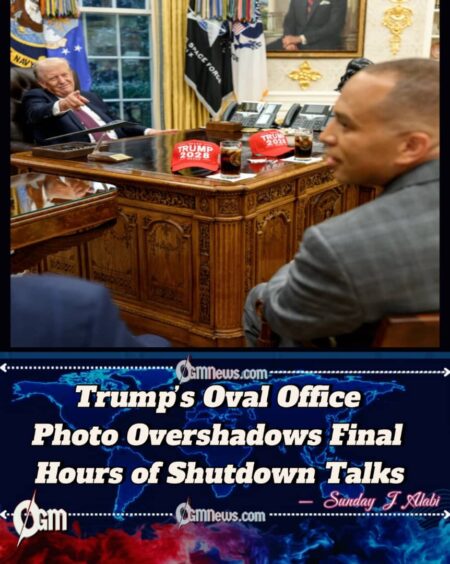
The United States federal government has entered an official shutdown after midnight on Wednesday, marking the first such lapse in funding since 2018. The stalemate came just hours after President Donald Trump, currently serving his second term, shared a behind-the-scenes photo from failed negotiations with Democratic leaders.
The dispute centers on Democratic demands to restore healthcare funding cuts enacted earlier this summer. Republicans, led by House Speaker Mike Johnson, had advanced a short-term continuing resolution (CR) to extend government funding through November, but Senate Democrats refused to back the measure, citing its lack of healthcare provisions.
With no compromise reached, government operations that are deemed non-essential—such as national parks, museums, passport offices, and federal loan services—have ground to a halt. Meanwhile, approximately 1.3 million military personnel and hundreds of thousands of federal workers now face furloughs or delayed paychecks.
Negotiations Collapse Amid Mockery By Trump and Distrust
The breakdown of talks came after a tense Oval Office meeting between Trump, Vice President JD Vance, and congressional leaders. In a photo posted to Truth Social, Trump placed “Trump 2028” hats on the Resolute Desk in front of Democratic leaders Chuck Schumer and Hakeem Jeffries, alongside two Diet Cokes.
Reports suggested the hats were offered as gifts, though Jeffries later disputed that claim, describing the moment as “the strangest thing ever.” According to witnesses, the room “erupted in laughter” when Jeffries asked Vance for his opinion on a potential Trump third term, and the vice president responded with a blunt “no comment.”
Despite the lighthearted moment, negotiations soon collapsed. Democrats rejected the Republican-led CR, while Trump doubled down on criticism of Democratic demands, accusing them of pushing policies that would provide healthcare benefits to undocumented immigrants and repeal parts of his domestic agenda.
Consequences for Workers and the Economy
As the Office of Management and Budget (OMB) sends out shutdown notices, the consequences are beginning to unfold. Federal employees are awaiting confirmation on whether they are classified as “essential” or “non-essential.” Those deemed non-essential face furloughs without pay, and in some cases, permanent layoffs through reduction-in-force notices.
For ordinary Americans, the shutdown will slow or halt access to key services. Passport processing, food safety inspections, veterans’ services, and Social Security inquiries will all face delays. National parks and museums are also expected to close. While border security, law enforcement, and emergency medical care will continue, many households will feel the impact of the disruption.
Economists predict the short-term economic consequences will be disruptive but not catastrophic. However, consumer confidence may suffer, especially as federal workers go without paychecks and uncertainty lingers about how long the impasse will last.
Both Parties Trump and Democrats Leaders Dig In Their Heels
Political leaders from both parties have blamed each other for the shutdown. Senate Majority Leader John Thune and Speaker Johnson accused Democrats of “bringing extraneous issues” into what they called a “clean” resolution. By contrast, Schumer insisted Republicans had frozen Democrats out of negotiations and introduced a proposal with “not one iota of Democratic input.”
President Trump appeared resolute, stating, “A lot of good can come from shutdowns.” He warned that his administration could use the shutdown to push irreversible policy changes that Democrats would not be able to undo.
With Republicans holding 53 Senate seats, they would need at least seven Democrats to cross party lines to pass the CR. As it stands, no agreement appears close, and the timeline for resolving the shutdown remains uncertain.


