








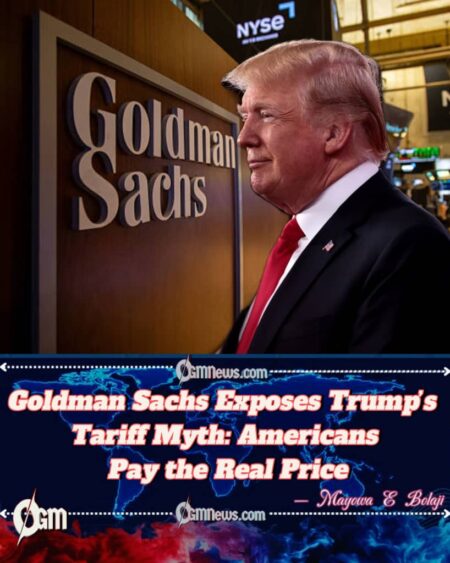
Goldman Sachs has rocked Washington’s economic establishment with a detailed analysis exposing Donald Trump’s long-standing claim that “foreign countries are paying” his tariffs as entirely false. According to the investment bank’s research, U.S. consumers are absorbing roughly 55% of all tariff costs, directly contradicting Trump’s insistence that the burden rests overseas. The report represents one of the most comprehensive studies yet of the real-world effects of Trump’s protectionist trade agenda.
Goldman Sachs revealed that consumer prices in the United States have been rising steadily since the tariffs were imposed earlier this year. The analysis found that inflationary pressure has intensified across multiple sectors — from groceries and consumer electronics to vehicles and construction materials. The study confirms what independent economists have long argued: that tariffs function as a domestic tax, ultimately paid by American households rather than by foreign governments or exporters.
Goldman Sachs also noted that some companies initially managed to cushion the blow by selling pre-tariff inventory, temporarily shielding consumers from full price increases. However, as those stockpiles diminish, businesses are being forced to raise prices to recover costs. This adjustment, the report warns, will likely accelerate inflationary trends and further reduce purchasing power for millions of Americans struggling under rising living expenses.
Goldman Sachs Warns of Rising Inflation and Deepening Consumer Strain
Goldman Sachs issued a sharp warning that the inflationary impact of Trump’s tariffs could escalate rapidly if additional levies are imposed. The report estimates that the tariffs have already contributed 0.44% to the Federal Reserve’s preferred inflation index, a significant increase in macroeconomic terms. Should the administration expand tariffs to include furniture, kitchen products, and household goods, that figure could reach 0.6%, meaning American consumers would bear as much as 70% of total tariff costs.
Goldman Sachs described the cumulative effect of Trump’s trade measures as a “hidden tax” that undermines wage gains and erodes household savings. The bank emphasized that tariff-related inflation has become a major factor in slowing consumer spending, which remains the backbone of the U.S. economy. In effect, the trade war that was meant to strengthen America’s position has instead shifted economic pain onto its own citizens.
Goldman Sachs further observed that the lack of coordination with key global partners — including Japan, South Korea, and the Netherlands — has weakened the U.S. position in global trade negotiations. While previous administrations sought collective leverage through multilateral cooperation, the current approach has alienated allies and eroded trust. The report concludes that without a reversal or recalibration of tariff policies, the U.S. could face persistent inflationary pressure for years to come.
Goldman Sachs Predicts Worsening Economic Fallout if Trump Persists with Tariffs
Goldman Sachs cautioned that unless Donald Trump reconsiders his trade strategy, the American economy could experience deeper instability in the months ahead. The report forecasts that tariff-driven inflation will continue to climb, particularly in essential sectors like food, home goods, and manufacturing. Despite overwhelming data, Trump has continued to insist that his tariffs are “making America rich,” a claim the report directly rebuts as economically inaccurate and politically misleading.
Goldman Sachs analysts stated that the longer tariffs remain in place, the greater the cumulative harm to consumers, small businesses, and agricultural producers. The study points out that farmers, particularly in the Midwest, are among the hardest hit — losing export markets to foreign competitors due to retaliatory tariffs. As a result, rural communities now face rising debt levels and an increased risk of bankruptcies, countering the administration’s promises to protect “America’s heartland.”
Goldman Sachs concluded its analysis by urging policymakers to adopt evidence-based trade strategies and prioritize relief measures for affected sectors. The firm warned that ignoring the data could entrench inflationary trends and weaken U.S. global credibility. The report also underscored that Trump’s refusal to acknowledge the economic consequences of his tariffs reflects a deeper problem — one rooted in political optics rather than fiscal prudence.