










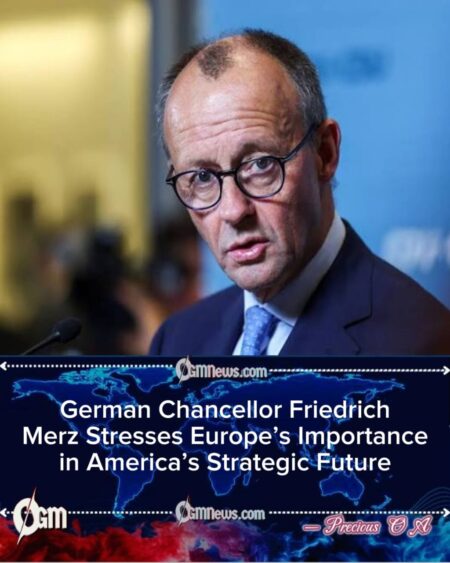
German Chancellor Friedrich Merz, during ongoing dialogue with American officials, underscored the importance of balanced cooperation between both nations. He emphasized that while the U.S. is entitled to protect its national interests, pursuing policies rooted in “America Alone” would weaken the alliances that have historically strengthened global security. His remarks reflected growing European concerns about unilateral tendencies within U.S. foreign policy.
Friedrich Merz reiterated that Europe remains a crucial partner in shaping international stability. He explained that transatlantic relationships must evolve but not fracture, especially in a period marked by geopolitical rivalry, cyberattacks, and shifting global power. According to him, Germany expects mutual respect and reciprocal engagement rather than one-sided decision-making.
Friedrich Merz warned that policies executed without consulting allies increase the risk of diplomatic miscalculations. He expressed that the U.S., despite its global capability, benefits significantly from strategic partnerships. His statement aimed to reinforce to American leaders that collective action, not isolation, is the more effective path toward shared prosperity and security.
Economic Policy and Shared Market Interests
Friedrich Merz highlighted that robust cooperation between the U.S. and Germany is essential for the stability of global markets. He argued that economic decoupling or restrictive trade barriers may produce short-term national gains but typically result in long-term collective setbacks. Germany, he noted, seeks policies that sustain open markets, predictable supply chains, and fair competition.
Friedrich Merz explained that Europe is prepared to collaborate on technological advancement, green innovation, and industrial modernization. He insisted, however, that such cooperation requires the U.S. to treat European partners as equals, not as secondary participants in global economic planning. According to him, a partnership built on shared values offers greater benefits than one dominated by unilateral directives.
He further addressed concerns about rising protectionism in the U.S., warning that retaliatory economic measures from Europe could become unavoidable if imbalances persist. Merz emphasized that Germany remains committed to diplomacy but will defend its industries when necessary. His comments signaled a broader European expectation for fairness in transatlantic trade arrangements.
Security Cooperation and Global Stability
Friedrich Merz expressed that Germany continues to rely on strong defense ties with the United States, particularly through NATO. He stressed that both nations share responsibility in responding to global threats, including terrorism, instability in Eastern Europe, and rising authoritarianism. Germany, he said, is expanding its defense capacity to meet modern challenges.
Friedrich Merz insisted that European security cannot be separated from American security. He noted that joint exercises, intelligence-sharing agreements, and coordinated military planning have historically deterred aggression and preserved peace. His message was clear: dismantling these collaborative structures would leave both sides more vulnerable.
Friedrich Merz cautioned that strategic adversaries benefit whenever democratic nations appear divided. He argued that maintaining unity within NATO requires constant communication and mutual understanding. His remarks were directed at ensuring that America continues to value European perspectives in shaping defense strategies.
Diplomatic Relations and International Responsibilities
Friedrich Merz reaffirmed that diplomacy is most effective when approached collectively. He urged the U.S. to deepen its involvement in multilateral forums rather than withdraw from them, noting that global challenges do not respect national borders. Issues like climate change, pandemics, and human rights violations demand unified responses.
He emphasized Germany’s readiness to support diplomatic initiatives aimed at de-escalation in conflict zones. Merz highlighted that ignoring the input of longtime allies increases the risk of fragmented responses, weakening the overall impact of Western diplomacy. He stressed that consultations should precede major foreign policy decisions.
Friedrich Merz added that restoring trust in international agreements requires consistency from all participating nations. He noted that abrupt policy reversals erode credibility and diminish the willingness of other countries to cooperate. His remarks were aimed at encouraging greater predictability and accountability in American diplomatic conduct.
Strategic Partnerships Beyond Europe
Friedrich Merz emphasized that Germany’s partnerships extend beyond the European Union to regions such as Africa, Asia, and South America. He noted that collaborative engagements in these areas help address migration pressures, development challenges, and economic disparities. His comments highlighted Germany’s broader global outlook.
Friedrich Merz encouraged the U.S. to coordinate more closely with Europe in outreach to emerging economies. He argued that competing separately rather than collectively gives strategic advantages to rival nations with expansive global ambitions. Unified Western efforts, he said, yield stronger diplomatic and economic outcomes.
He further stressed that Germany welcomes initiatives that encourage sustainable development abroad, but such efforts must be transparent and balanced. Merz reiterated that America’s global presence is strengthened, not diminished, when it works alongside trusted partners. His position underscored the value of coalition-building in an increasingly contested world.
Reaffirming the Value of Alliance
Friedrich Merz concluded his message to American leaders with a strong appeal for renewed unity. He noted that political differences should never overshadow the long history of cooperation that has shaped the modern international order. Maintaining that unity requires deliberate commitment from both sides of the Atlantic.
Friedrich Merz pointed out that misunderstandings between allies often arise from inadequate communication rather than intentional disagreements. He called for more frequent consultations, structured dialogue, and shared strategic planning sessions. These mechanisms, he argued, help prevent tension and strengthen long-term collaboration.
He emphasized that Germany stands ready to work closely with the United States on economic, security, and diplomatic fronts. Merz maintained that partnerships built on trust, transparency, and mutual respect produce the greatest impact, reinforcing his central message: “America First is understandable, but America Alone is unsustainable.”


