









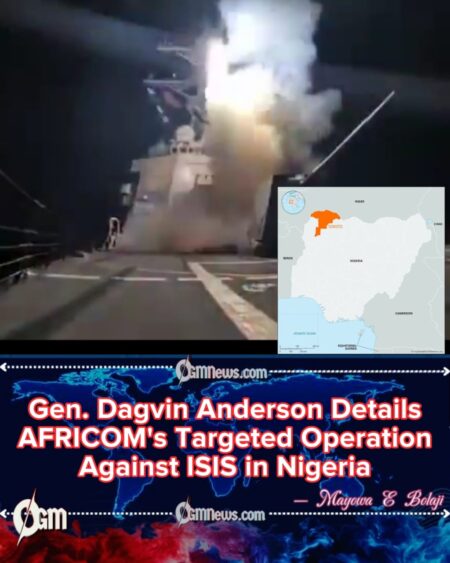
Gen. Dagvin Anderson has confirmed that U.S. Africa Command (AFRICOM) conducted a targeted airstrike against camps linked to the Islamic State (ISIS) in Sokoto State, northwestern Nigeria. The operation, carried out at the direction of the President of the United States and the U.S. Secretary of War, was executed in close coordination with Nigerian authorities as part of ongoing counterterrorism efforts in the region.
Gen. Dagvin Anderson said the strike reflects AFRICOM’s continued commitment to confronting violent extremist organizations that pose threats to civilian populations and regional stability. The confirmation has drawn attention to the evolving security challenges in northwestern Nigeria and the increasing international dimension of counterterrorism operations there.
Confirmation of the Sokoto Airstrike
Gen. Dagvin Anderson stated that the airstrike specifically targeted ISIS terrorist camps operating within Sokoto State. According to AFRICOM, the decision followed intelligence assessments indicating that the locations were being used to support extremist activities.
Gen. Dagvin Anderson emphasized that operational details remain limited for security reasons, but noted that the strike was carefully planned and executed to degrade the operational capacity of ISIS-linked elements without broadening the conflict.
Coordination with Nigerian Authorities
Gen. Dagvin Anderson highlighted that the operation was conducted in close coordination with Nigerian authorities, underscoring the importance of partnership in addressing shared security threats. He noted that cooperation with Nigeria includes intelligence sharing and strategic alignment.
Gen. Dagvin Anderson added that such collaboration is essential given Nigeria’s complex security landscape, which includes insurgency, banditry, and the emergence of extremist cells in multiple regions of the country.
Direction from U.S. Leadership
Gen. Dagvin Anderson confirmed that the airstrike was authorized at the highest levels of the U.S. government, following directives from the President of the United States and the Secretary of War. This, he said, demonstrates Washington’s continued focus on preventing terrorist groups from establishing safe havens.
Gen. Dagvin Anderson noted that U.S. leadership views counterterrorism in Africa as integral to broader global security, particularly in regions where extremist groups could exploit weak governance or ongoing instability.
AFRICOM’s Counterterrorism Mission
Gen. Dagvin Anderson said the operation aligns with AFRICOM’s broader mission to work alongside African and regional partners to counter violent extremism.
“U.S. Africa Command is working with Nigerian and regional partners to increase counterterrorism cooperation efforts related to on-going violence and threats against innocent lives,” he stated.
Gen. Dagvin Anderson reiterated that AFRICOM’s core objective is to protect Americans while disrupting violent extremist organizations wherever they operate, using a combination of military precision and partnership-based approaches.
Civilian Protection and Strike Assessment
Gen. Dagvin Anderson stressed that the U.S. military took extensive measures to prevent civilian casualties during the airstrike. He said AFRICOM applies rigorous intelligence verification and targeting standards before conducting any kinetic operation.
Gen. Dagvin Anderson added that the command will continue to assess the results of the strike, including its effectiveness and any unintended consequences, as part of standard post-operation review procedures.
Implications for Security in Northwestern Nigeria
Gen. Dagvin Anderson noted that the confirmation of ISIS-linked camps in Sokoto State points to shifting security dynamics in northwestern Nigeria, an area traditionally affected by banditry rather than organized extremism.
Gen. Dagvin Anderson said that while targeted strikes can disrupt immediate threats, long-term stability in the region will depend on sustained local security efforts, regional cooperation, and broader strategies to address the root causes of violence.