








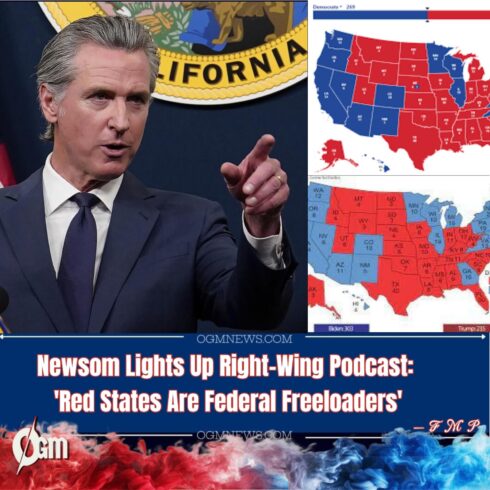
In a fiery appearance on a right-wing podcast this week, California Governor Gavin Newsom asserted that blue states like California generate 71% of the U.S. economic output, while red states depend on federal support, effectively labeling them “welfare states.” Newsom’s remarks ignited strong reactions across the political spectrum and renewed debates over America’s fiscal divide.
Gavin Newsom Framed Blue States as Economic Engines
During the podcast, Gov. Gavin Newsom emphasized California’s economic dominance, arguing that blue states serve as the financial backbone of the nation. Citing figures that show California alone contributing over $80 billion more to the federal budget than it receives, he portrayed blue states as the true “donor” regions subsidizing the rest of the country.
His assertion aligns with longstanding federal data: states such as New York, Massachusetts, and New Jersey regularly pay more in federal taxes than they receive back in federal spending. By highlighting these statistics, Newsom aimed to reinforce the narrative of blue states as highly productive, innovative, and economically resilient, even as they grapple with their own internal crises.
Red States Labeled “Welfare States” by Gavin Newsom
Gavin Newsom’s sharpest claim came when he described red states as “welfare states,” suggesting that they take far more from Washington than they contribute. This framing echoes research from the Financial Times and Time, which found that red states receive disproportionate benefits through defense contracts, disaster aid, farm subsidies, and social programs.
For example, Missouri, North Carolina, and Alaska receive thousands more per capita in federal spending than they pay in taxes. This pattern is not new; decades of data show a consistent net transfer of resources from wealthier, urban blue states to more rural, lower-income red states. Newsom’s rhetorical choice to call them “welfare states,” however, struck a deeply political chord.
Backlash Across the Political Spectrum
Predictably, Gov. Gavin Newsom’s remarks were met with swift condemnation from conservative commentators, who labeled his comments as elitist and dismissive of rural America. Right-wing pundits accused Newsom of hypocrisy, pointing out blue states’ reliance on federal disaster assistance and infrastructure funding.
Meanwhile, criticism also arose from the left. Progressive voices, including California Democrats and opinion writers from the Washington Post and The New Yorker, warned that Newsom’s combative language could alienate moderate voters and distract from pressing state issues like homelessness, housing shortages, and wildfire preparedness. Some accused him of opportunistically stoking regional divisions to bolster a potential national profile.
The Numbers Behind the Claims
Beyond rhetoric, data supports the broad contours of Gavin Newsom’s argument. According to a Time report, between 2018 and 2022, blue states generated about 60% of federal tax revenue but received only 53% back in spending. In contrast, red states contributed 40% of revenue but took home 47% in spending, translating to a net transfer of roughly $1 trillion during that period.
Further analysis by MarketWatch shows that per capita GDP in blue states averages around $69,000, significantly higher than the $55,000 typical in red states. This disparity reflects structural economic differences: blue states thrive on technology, finance, and services, while red states rely more heavily on agriculture, manufacturing, and extractive industries.
The Social Safety Net Dimension
A critical point of contention is what constitutes “welfare.” Many federal transfers to red states come in the form of social insurance programs like Social Security, Medicare, and Medicaid. Axios reported that counties voting for President Trump in 2020 are among the most reliant on these programs, with 63% of voters in transfer-dependent counties supporting him.
Brookings Institution studies further show that while blue states spend more on state-directed benefits like earned income tax credits and child care, red states still depend heavily on federal dollars for essential services. Gavin Newsom’s framing may therefore oversimplify a complex web of interdependencies that underpin national economic stability.
A Strategy or a Misstep?
Some observers view Gavin Newsom’s remarks as part of a broader strategy to draw sharp contrasts between progressive governance and conservative dependency on federal support—particularly amid ongoing tensions with President Trump’s administration. The Guardian and CapRadio noted that this rhetoric fits into Newsom’s long-running narrative positioning California as a model of economic strength and liberal values.
Others, however, see it as a political miscalculation that risks deepening polarization. As the 2024 presidential election cycle intensifies and national attention pivots toward economic recovery and social cohesion, comments like Newsom’s may inadvertently reinforce cultural and regional divides rather than bridge them.
Fiscal Realities Meet Political Theater
At its core, Gavin Newsom’s claim is rooted in factual fiscal imbalances that have persisted for decades. Blue states, by virtue of their larger economies and higher incomes, do fund a significant portion of federal spending. Red states, conversely, benefit from these transfers in the form of critical public services and economic support.
Yet, the blunt language of “welfare states” risks overshadowing the nuances of national unity and shared economic fate. While Newsom’s comments may resonate with certain progressive audiences, they also highlight the fragile balance between economic data and political messaging—an equilibrium that will remain central as debates over federal spending and state contributions continue to shape America’s political landscape.