





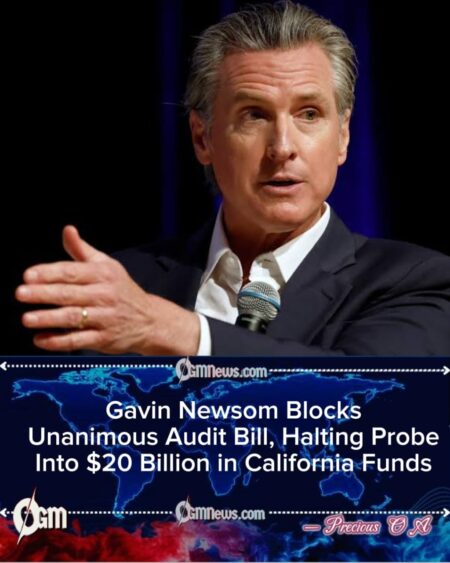
Gavin Newsom vetoed legislation that had passed unanimously through the California Legislature, blocking a proposal that would have required a comprehensive audit into roughly $20 billion in state funds that lawmakers say remain unaccounted for across multiple programs. The decision immediately set off controversy at the Capitol, given the rare bipartisan agreement behind the bill.
The veto halted what supporters described as a routine oversight measure designed to clarify how large sums of public money were allocated and tracked. Legislators from both parties had framed the audit as a transparency tool rather than an accusation of wrongdoing, emphasizing its unanimous passage as evidence of broad concern.
Supporters of the bill expressed surprise that such a widely backed measure was rejected. Several lawmakers noted that unanimous votes are uncommon in Sacramento, particularly on fiscal oversight, making the governor’s decision stand out even more sharply.
Gavin Newsom Defends His Veto
Gavin Newsom argued that the proposed audit was unnecessary and potentially duplicative of existing financial controls already in place within state government. In his veto message, he emphasized that California undergoes regular financial reviews and that additional mandates could divert resources from ongoing accountability efforts.
In public statements following the veto, the governor’s office stressed that the funds in question were spread across long-term programs, emergency appropriations, and multi-year initiatives, making the phrase “missing money” misleading. Officials said existing reporting mechanisms already provide sufficient visibility into state finances.
Gavin Newsom also warned that the audit, as written, could slow down essential services by imposing broad requirements on agencies already facing staffing and administrative pressures. He framed the decision as one rooted in efficiency rather than resistance to scrutiny.
Lawmakers React Across Party Lines
Gavin Newsom found himself facing criticism not only from political opponents but also from members of his own party. Several Democratic lawmakers said privately that the veto undercut the Legislature’s constitutional role in overseeing public spending.
Republican legislators were more vocal, accusing the administration of blocking transparency. They argued that if the state’s accounting systems were as robust as claimed, an independent audit would only reinforce public confidence.
Gavin Newsom was repeatedly cited during floor debates and media appearances as lawmakers questioned why an audit with no partisan opposition was deemed unnecessary. The veto quickly became a focal point in broader discussions about accountability in one of the nation’s largest state budgets.
Questions Surround the Missing Funds
At the center of the dispute is the characterization of the $20 billion figure. Legislative analysts have said the number reflects funds that are difficult to trace in consolidated reports, rather than money confirmed to be lost or misused.
Auditors and fiscal experts note that California’s budget is vast and complex, spanning thousands of programs and multiple fiscal years. They caution that gaps in reporting do not automatically imply misconduct, but they also acknowledge that clearer accounting could reduce confusion.
Gavin Newsom maintained that the administration is already working to modernize financial tracking systems. His office pointed to ongoing upgrades intended to improve real-time visibility into spending without the need for a sweeping external audit.
Transparency, Oversight, and Public Trust
Transparency advocates argue that perception matters as much as process. When large sums of money are described as unaccounted for, they say, public trust erodes regardless of technical explanations.
Gavin Newsom has countered that public trust is also undermined when complex fiscal realities are oversimplified. He has repeatedly said that responsible governance requires balancing openness with accuracy and administrative practicality.
Good-government groups remain divided. Some support the governor’s stance, saying redundant audits can waste taxpayer dollars, while others insist that an independent review would have reassured Californians amid rising concerns over government spending.
What Comes Next for California
Gavin Newsom now faces pressure to propose alternative transparency measures that could address legislative concerns without reviving the vetoed bill. Observers say voluntary disclosures or targeted reviews could serve as a compromise.
Lawmakers are exploring options to reintroduce revised legislation or attach audit requirements to future budget negotiations. Some have suggested narrowing the scope to specific agencies or programs to avoid broad administrative burdens.
Gavin Newsom has indicated that discussions with legislative leaders will continue, signaling that while the veto stands, the broader debate over fiscal accountability in California is far from settled.