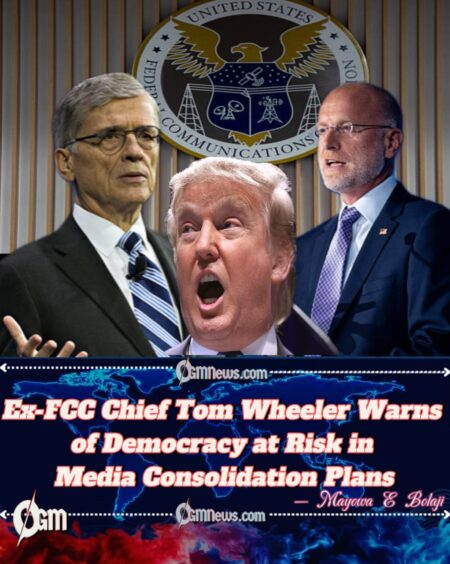
Former FCC Chair Tom Wheeler has issued a strong warning about proposed regulatory changes that could reshape who controls the nation’s broadcast landscape. According to Wheeler, one of the most powerful tools in the hands of any autocrat is the ability to monopolize storytelling, thereby controlling the flow of information to the public. When a small group of corporations or political allies gain unchecked influence over media platforms, he argued, the diversity of debate essential to democracy is compromised.
Former FCC Chair Tom Wheeler Warns of Threat to Democracy in Proposed Broadcast Ownership Changes reflected on the history of U.S. broadcasting, noting that the foundation of American communications policy was enshrined in the 1934 Communications Act. This act emphasized diversity of voices and ownership as essential to protecting free debate and democratic governance. Over the decades, however, Wheeler said these protections have eroded, leaving local communities with little control over the narratives reaching their airwaves. Today, only about one-fifth of so-called “local” broadcast outlets are genuinely locally owned, a shift that has centralized media power in fewer hands.
Former FCC Chair Tom Wheeler Warns of Threat to Democracy in Proposed Broadcast Ownership Changes cautioned that this centralization poses a direct threat to pluralism in media. With fewer independent outlets, Americans risk receiving homogenized news coverage that reflects the priorities of powerful corporations rather than the interests of local communities. He argued that allowing media ownership consolidation under politically aligned corporations could undermine democratic accountability at a moment when public trust in institutions is already fragile.
Former FCC Chair Points to Pending Merger as Test Case
Former FCC Chair Tom Wheeler Warns of Threat to Democracy in Proposed Broadcast Ownership Changes highlighted the proposed merger between Nexstar Media Group, the nation’s largest chain of broadcast outlets, and Tegna, another large broadcaster, as a concrete example of the dangers posed by these regulatory shifts. Under current FCC rules, the merger would be illegal, since it violates limits on both national reach and local ownership. Nonetheless, the two companies have already reached an agreement, awaiting only the regulatory green light to proceed.
Former FCC Chair Wheeler explained that this merger encapsulates the broader problem: a willingness to change long-standing rules to accommodate corporate consolidation. If approved, it would expand Nexstar’s dominance over both national and local broadcasting markets, further eroding the diversity of independent voices. This centralization, he argued, would silence smaller local broadcasters who often provide perspectives absent from corporate-owned stations.
Former FCC Chair Tom Wheeler Warns of Threat to Democracy in Proposed Broadcast Ownership Changes further stressed that the initiative announced by current FCC Chairman Brendan Carr seems tailored to make such deals legal after the fact. By loosening national reach limits and weakening restrictions on local control, regulators would effectively sanction a monopoly over the public’s airwaves. Wheeler said the prospect is deeply troubling, not only because it reduces competition, but also because it hands disproportionate influence to corporations that have explicitly aligned themselves with Trump-friendly politics.
Former FCC Chair Warns of Democratic Erosion Through Media Capture
Former FCC Chair Tom Wheeler Warns of Threat to Democracy in Proposed Broadcast Ownership Changes underscored that the stakes extend far beyond business or regulatory concerns; at their core, the proposed changes risk undermining democratic governance itself. If fewer corporations are allowed to dominate the airwaves, then the range of voices, debates, and dissent essential to democracy will inevitably narrow. For Former FCC Chair Tom Wheeler Warns of Threat to Democracy in Proposed Broadcast Ownership Changes, this is not merely a policy debate—it is a fundamental test of whether the United States will preserve media pluralism or succumb to information monopolies.
Former FCC Chair Tom Wheeler Warns of Threat to Democracy in Proposed Broadcast Ownership Changes argued that when corporations tied to political movements gain excessive control over broadcasting, the danger is not simply corporate dominance but partisan capture of the media environment. Such a scenario, he said, mirrors the strategies employed by authoritarian regimes worldwide, where state-aligned entities dictate the national narrative and dissenting voices are marginalized or silenced. For a democracy built on open debate, this trajectory could prove catastrophic.
Former FCC Chair Tom Wheeler Warns of Threat to Democracy in Proposed Broadcast Ownership Changes concluded that the FCC’s role as a guardian of public interest must be preserved, not repurposed to consolidate power. He urged policymakers, media professionals, and the public to resist efforts that reduce diversity in ownership and programming. Without vigilance, he warned, the very principles of democratic communication—pluralism, accountability, and freedom of expression—could be sacrificed for short-term political and corporate gain.