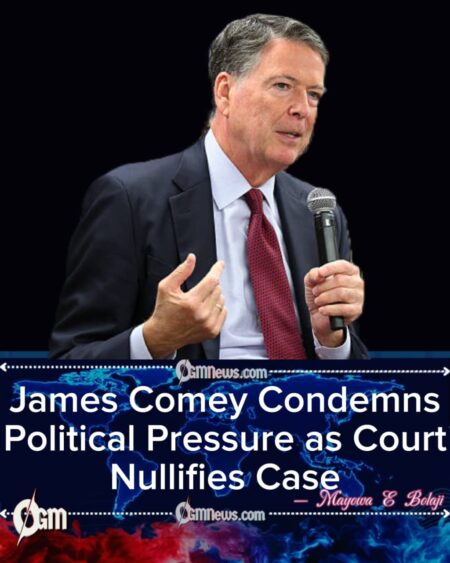
Former FBI Director James Comey has triggered a nationwide conversation on the limits of presidential power after a federal judge dismissed the case against him, ruling that the special prosecutor assigned to investigate him was unlawfully appointed. The decision abruptly ended a highly scrutinized investigation and prompted Comey to release a pointed video criticizing President Donald Trump, who is currently serving his second term.
In the video, Comey declared: “The president of the United States cannot use the Department of Justice to target his political enemies.” He warned that when the justice system is bent toward political payback, the rule of law weakens and “democracy is at stake.”
James Comey Reacts to Judge’s Ruling on Unlawful Appointment
James Comey’s response came quickly after the judge concluded that the prosecutor who handled his case did not have the legal authority required under federal statutes. According to the ruling, the appointment bypassed essential procedures, rendering the entire prosecution invalid.
The court’s decision not only voids the case but also brings renewed attention to how federal prosecutors are selected and supervised. Legal observers note that while the ruling centers on procedural flaws, its implications stretch into broader debates over executive overreach.
Many analysts argue that the decision strengthens calls for clarity and consistency in Justice Department appointments to prevent similar breakdowns in future investigations.
James Comey Condemns Political Retaliation in New Video Release
James Comey used his video message to cast the failed prosecution as an act of political retaliation rather than an impartial inquiry. He argued that the Justice Department appeared weaponized against him, motivated by personal and political grievances rather than evidence.
Comey stressed that a justice system used to pursue political enemies cannot be trusted by the public and risks becoming a tool of authoritarian impulses. His message has gained wide attention online, drawing both praise and criticism.
Supporters say Comey’s blunt remarks highlight ongoing concerns about improper political influence, while critics contend he is reframing events to deflect scrutiny from his past leadership at the FBI.
James Comey’s Warning Sparks White House and Congressional Reactions
James Comey’s remarks prompted swift commentary from political figures. While the White House has remained reserved in its formal response, officials close to President Trump have defended the legitimacy of the original investigation and denied that the president exerted improper influence over the Justice Department.
Opponents of the administration, however, argue that Comey’s case illustrates a broader pattern of political pressure on federal institutions. Members of Congress—both Republican and Democrat—have indicated they may seek oversight hearings to determine how the invalid appointment was made.
The fallout from the ruling has intensified the ongoing debate over institutional independence and the separation of powers within the federal government.
James Comey’s Case Raises New Questions for Legal Experts
James Comey’s dismissed prosecution has prompted legal scholars to reexamine the structures governing special prosecutors and their oversight. Analysts say the ruling reinforces the need for strict compliance with statutory requirements to prevent politically motivated investigations.
Experts caution that if these procedures are not followed consistently, future legal actions may face similar challenges, undermining trust in federal law enforcement. They note that transparency in appointments is essential for sustaining the credibility of the justice system.
Many legal professionals believe that the Comey case may push lawmakers to revisit and reform how special counsels and prosecutors are chosen within the Justice Department.
James Comey Highlights Broader Threats to Rule of Law
James Comey’s warning that “democracy is at stake” has deepened public debate about the health of key democratic institutions. His comments resonate at a time when political polarization and mistrust of federal agencies are at historic highs.
Advocates for judicial independence say the case should serve as a catalyst for renewed commitments to fairness, nonpartisanship, and transparent governance. They argue that ignoring such events risks weakening the foundational principles that safeguard democracy.
Even with the case closed, the concerns Comey raised are likely to shape political and institutional discourse for months ahead.
James Comey Inspires Calls for Reform and Oversight
James Comey’s situation has energized activists and lawmakers pushing for reforms to prevent the perceived politicization of federal law enforcement. Some members of Congress have already signaled support for reviewing Justice Department protocols regarding special prosecutor appointments.
Civil society groups emphasize that restoring public confidence will require not only procedural reform but also a renewed commitment to ethical leadership within federal agencies. They insist that safeguarding democratic principles depends on preventing political manipulation of the justice process.
Whether these efforts will lead to substantial legislative change remains uncertain, but Comey’s case has undoubtedly reopened debates about accountability, transparency, and executive power.