










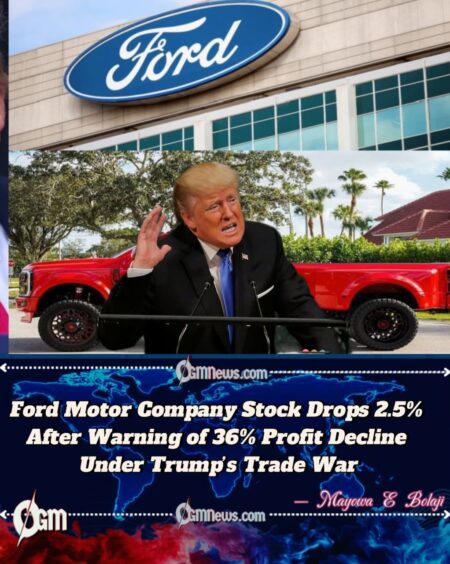
Ford Motor Company has announced that its profits could drop by as much as 36% this year, citing President Donald Trump’s tariff policies as a primary factor. The automaker expects adjusted earnings before interest and taxes (EBIT) to fall between $6.5 billion and $7.5 billion, a significant downgrade from its earlier forecast of $7 billion to $8.5 billion.
Ford Motor Company revealed that last year’s earnings stood at $10.2 billion, underscoring the severity of the decline expected in 2025. Company officials said the latest projection is worse than previously anticipated and reflects the cumulative impact of tariffs on its operations, suppliers, and consumers.
Ford Motor Company Reports $2 Billion in Tariff-Driven Costs
Ford Motor Company estimates that tariffs will drain approximately $2 billion from its adjusted earnings this year, up from the $1.5 billion hit previously predicted. The increase in tariff-related costs stems largely from higher import duties on key automotive components and raw materials.
FMC Chief Financial Officer Sherry House stressed that President Trump’s decision to double steel and aluminum tariffs from 25% to 50% was “notably damaging” to the company’s bottom line. These metals are essential in the production of vehicles, and the escalating tariffs have driven up costs across Ford’s supply chain.
Ford Motor Company Challenges MAGA Economic Assumptions
Ford Motor Company, despite producing more vehicles in the United States than any other automaker, has not been shielded from the financial fallout of tariffs. The company’s latest results challenge the assumption that domestic manufacturing alone would protect American companies from trade policy disruptions.
FMC emphasized that the tariffs are producing broadly destructive ripple effects, as costs on imported components climb and consumer spending power diminishes. “These measures are hurting the very companies they were meant to protect,” a company spokesperson said.
FMC Links Tariffs to Weakened Consumer Spending
Ford Motor Company has also noted that tariffs on unrelated consumer goods are squeezing household budgets. The automaker reported that buyers now have less disposable income to spend on new vehicles, a trend that is weighing heavily on sales.
FMC warned that shrinking consumer demand could deepen its financial losses. If households continue to redirect spending toward higher-priced essentials, the company anticipates even steeper declines in vehicle purchases.
Ford Motor Company Shares Fall on Wall Street
Ford Motor Company’s profit warning sent shockwaves through the market, pushing shares down 2.5% in after-hours trading. Analysts expect further market turbulence as Wall Street evaluates the company’s revised forecast.
FMC explained that the volatility in the auto industry has been heightened by shifting trade policies, which have complicated production planning and pricing strategies. Investors remain cautious as tariff negotiations continue.
Ford Motor Company Notes Industry-Wide Challenges
Ford Motor Company stressed that its struggles are reflective of wider challenges facing U.S. automakers. Steel and aluminum tariffs have inflated production costs across the industry, while import duties on parts have disrupted supply chains worldwide.
FMC said its rivals are also experiencing reduced margins and uncertain demand. Analysts have cautioned that the current tariff regime could erode the global competitiveness of American auto brands if not addressed.
FMC Calls for Tariff Policy Reassessment
FMC, while careful not to criticize President Trump directly, has urged policymakers to reconsider the economic consequences of the sweeping tariff hikes. CFO Sherry House stated that the company remains committed to domestic manufacturing but warned that current trade measures are “unsustainable for long-term growth.”
Ford Motor Company added that industry groups have echoed its concerns, pressing the administration to adopt a more targeted approach to trade disputes. They argue that the tariffs, as currently structured, are harming American workers, suppliers, and consumers alike.
Ford Motor Company Highlights Broader Economic Implications
FMC warned that its projected $2 billion loss raises significant questions about the wider impact of Trump’s trade policies on major U.S. companies. Economists fear that prolonged financial strain on leading manufacturers could slow job growth and reduce investment across the economy.
FMC concluded that the tariffs are acting like a tax on American industry. “If companies like Ford continue to struggle,” the automaker said, “the ripple effects could extend far beyond the auto sector.”


