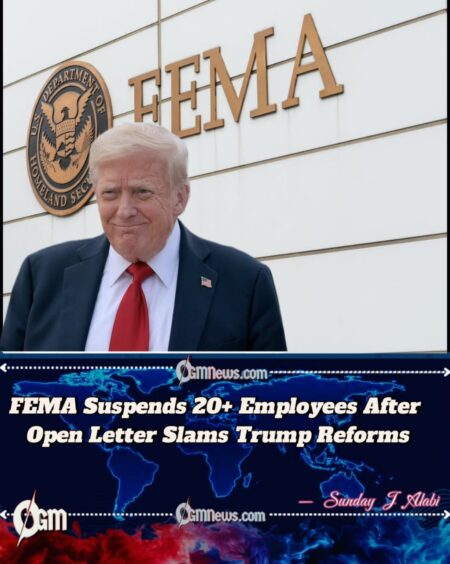
The Federal Emergency Management Agency has placed more than 20 current employees on paid administrative leave following their participation in an open letter that criticized the Trump administration’s changes to the disaster relief agency. The suspensions came just one day after the publication of the “Katrina Declaration,” which warned of potential rollbacks to critical post-Hurricane Katrina reforms.
The controversy highlights growing tensions within FEMA as President Trump pursues sweeping changes to the agency, including significant workforce reductions and structural reforms. The timing of the letter, published on the 20th anniversary of Hurricane Katrina, underscores concerns about the agency’s future direction and capacity to respond to major disasters.
Employee Letter Triggers Swift Administrative Action
On Tuesday evening, current FEMA employees who had signed the open letter with their names attached received emails notifying them of their immediate suspension. The correspondence, reviewed by opitanglobamedia News, stated that the employees were being placed on “paid administrative leave effective immediately, and continuing until further notice.” The emails emphasized that the action was “not a disciplinary action and is not intended to be punitive.”
The suspended employees were prohibited from entering FEMA facilities, accessing departmental telecommunications systems, or performing their official duties, with the exception of responding to Department of Homeland Security inquiries. Despite the restrictions, the staff members were required to remain available during standard business hours and would continue receiving their regular pay and benefits throughout the suspension period.
The emails provided no explicit reasoning for the administrative action, leaving employees and observers to connect the timing with the publication of the critical letter. The swift response suggests a coordinated effort by agency leadership to address what they may view as internal dissent during a period of significant organizational change.
The “Katrina Declaration” Raises Alarm About Agency Direction
The open letter, dubbed the “Katrina Declaration,” was signed by 191 current and former FEMA employees, though only 35 chose to attach their names publicly. The remaining signatories withheld their identities, citing fears of potential retaliation—concerns that appear to have been validated by the subsequent suspensions.
Published to coincide with Hurricane Katrina’s 20th anniversary, the declaration argued that the Trump administration was systematically undoing critical reforms implemented after the devastating 2005 hurricane. The letter specifically accused President Trump of appointing unqualified personnel to leadership positions within FEMA and criticized the administration’s approach to workforce management and disaster preparedness funding.
The employees expressed particular concern about cuts to grants designed to help state and local governments strengthen their infrastructure against natural disasters. They warned that these changes could lead to “not only another national catastrophe like Hurricane Katrina, but the effective dissolution of FEMA itself and the abandonment of the American people such an event would represent.”
Trump Administration Defends Reform Agenda
FEMA acting press secretary Daniel Llargues responded to the criticism by defending the administration’s disaster response record and characterizing the changes as necessary modernization efforts. He argued that the agency had previously been “bogged down by red tape, inefficiency, and outdated processes” that hindered its effectiveness in serving disaster survivors.
“The Trump Administration has made accountability and reform a priority so that taxpayer dollars actually reach the people and communities they are meant to help,” Llargues stated. He dismissed the employee concerns as resistance from bureaucrats who had “presided over decades of inefficiency” and were now “objecting to reform.”
The administration’s defense reflects a broader narrative about government efficiency and accountability that has characterized President Trump’s approach to federal agencies. Officials have consistently argued that structural changes, including workforce reductions, are necessary to create a more responsive and cost-effective disaster relief system.
FEMA Significant Workforce Changes Already Underway
The suspensions occur against the backdrop of substantial staffing changes at FEMA, with the agency losing approximately one-third of its workforce this year through a combination of terminations and voluntary departures. These reductions represent one of the most significant downsizing efforts in the agency’s recent history and have raised questions about operational capacity during peak disaster seasons.
President Trump has previously suggested either “getting rid of FEMA” entirely or “fundamentally reforming” the agency by transferring many of its responsibilities to state governments. This decentralization approach represents a philosophical shift away from the federal government’s traditional role as the primary coordinator of large-scale disaster response efforts.
The workforce reductions have affected various departments within FEMA, from field operations to administrative functions. Critics argue that these cuts could compromise the agency’s ability to respond effectively to major disasters, while supporters contend that a leaner organization will be more agile and efficient in its operations.
Historical Context of Post-Katrina Reforms
Hurricane Katrina’s catastrophic impact in 2005 led to comprehensive reforms of the nation’s disaster response system, many of which the current employee letter seeks to protect. The storm’s aftermath revealed significant coordination failures between federal, state, and local agencies, prompting Congress and successive administrations to implement structural changes designed to improve preparedness and response capabilities.
These reforms included enhanced pre-positioning of resources, improved communication systems, and stronger partnerships with state and local governments. The establishment of clearer command structures and the development of more robust logistics capabilities were also key components of the post-Katrina transformation.
The employees who signed the declaration argue that dismantling these reforms could leave the nation vulnerable to repeating the failures that characterized the Katrina response. They contend that the institutional knowledge and operational improvements developed over nearly two decades could be lost through hasty restructuring efforts.
Questions About Future Agency Operations
The suspension of employees who voiced concerns about agency direction raises broader questions about internal dissent and employee rights within federal agencies. While the administration has characterized the suspensions as non-punitive administrative actions, the timing and scope suggest a clear message about the consequences of public criticism.
Legal experts and federal employee advocates are likely to scrutinize whether the suspensions constitute retaliation for protected speech, particularly given that the employees were exercising their rights to communicate with Congress. The distinction between disciplinary action and administrative leave may become a crucial factor in any potential legal challenges.
The controversy also highlights the challenge facing federal agencies undergoing significant transformation while maintaining operational readiness. As FEMA continues to implement reforms, the agency must balance the need for change with the preservation of institutional capabilities essential for disaster response. The resolution of this internal conflict may ultimately determine the agency’s effectiveness in protecting American communities from future natural disasters.