







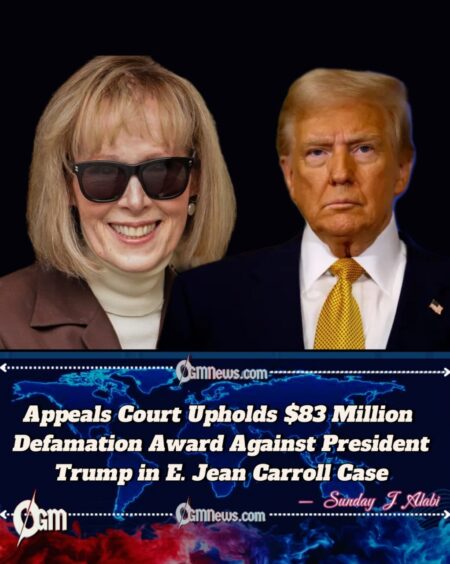
A federal appeals court has unanimously affirmed an $83.3 million defamation judgment against President Donald Trump, marking another significant legal defeat in a case stemming from decades-old sexual assault allegations made by writer E. Jean Carroll.
Court Rejects All Presidential Arguments
The U.S. Court of Appeals for the 2nd Circuit delivered a comprehensive rejection of President Trump’s legal challenges on Monday, finding that the trial court committed no errors in its handling of the high-profile case. The three-judge panel declared the jury’s substantial damages award “fair and reasonable” given what they described as the “extraordinary and egregious facts” surrounding the defamation claims.
President Trump’s legal team had mounted several defense strategies, including assertions of presidential immunity protection and claims that the trial proceedings were fundamentally flawed. They also argued that the $83.3 million damage award far exceeded reasonable compensation standards. However, the appeals court systematically dismantled each argument, upholding both the trial court’s procedural decisions and the jury’s financial judgment.
The court’s decision represents the latest unsuccessful attempt by Trump’s attorneys to overturn adverse rulings in the Carroll litigation, which has produced two separate jury verdicts against the president totaling more than $88 million in combined damages.
Carroll’s Legal Victory Reinforced
E. Jean Carroll’s attorney, Roberta Kaplan, characterized the appeals court ruling as a vindication of her client’s truthfulness and a condemnation of President Trump’s public statements. Kaplan emphasized that the court found Trump acted with “reckless indifference” to Carroll’s “health and safety” when making defamatory remarks about the writer’s sexual assault allegations.
The attorney expressed satisfaction that the appellate process had reached what she hoped would be its conclusion, stating that “justice will finally be done” for her client. Kaplan’s comments reflected years of legal battles that began when Carroll first publicly accused Trump of sexually assaulting her in a Bergdorf Goodman department store during the 1990s.
Carroll’s legal team has consistently maintained that Trump’s public denials and characterizations of her allegations as fabricated constitute defamation that severely damaged her reputation and personal well-being. The appeals court’s affirmation suggests federal judges at multiple levels have found merit in these arguments.
Trump Legal Team Denounces Ruling
A spokesman for President Trump’s legal team responded to the appeals court decision with sharp criticism, characterizing the entire legal proceeding as politically motivated persecution. The spokesman described the case as a “Democrat-funded travesty” and accused the justice system of being weaponized against the president for partisan purposes.
Despite the legal setback, Trump’s representatives expressed confidence in the president’s broader legal strategy, suggesting he would continue to prevail against what they termed “Liberal Lawfare.” The spokesman indicated that Trump remains focused on his presidential duties and his campaign promise to “Make America Great Again,” rather than being distracted by ongoing litigation.
The response reflects a consistent pattern from Trump’s legal team of framing adverse court rulings as evidence of systemic bias rather than legitimate judicial determinations. This messaging strategy appears designed to maintain political support while navigating multiple legal challenges.
Background of Long-Running Legal Battle
The Carroll defamation case represents one of two separate legal victories the writer has secured against President Trump in federal court. The current $83.3 million judgment stems from a 2024 trial focused specifically on defamatory statements Trump made about Carroll after she went public with her allegations in 2019.
A previous 2023 trial resulted in a separate $5 million judgment after a federal jury found Trump liable for sexual abuse and defamation. That case centered on Carroll’s core allegation that Trump “forcefully inserted his fingers” into her during the alleged department store encounter. The same appeals court upheld that earlier judgment in June, creating a pattern of sustained legal defeats for the president.
The legal proceedings have been marked by contentious courtroom behavior, with the appeals court noting that Trump “made several disruptive comments and gestures in front of the judge and jury” during the 2024 trial. This conduct appears to have influenced the court’s assessment of the overall case dynamics and Trump’s approach to the litigation.
Jury Heard Evidence of Substantial Damages
During the 2024 trial that produced the $83.3 million judgment, jurors were presented with detailed evidence and expert analysis documenting the reputational and personal harm Carroll suffered following Trump’s public denials of her allegations. The testimony painted a picture of a woman whose life and career were significantly disrupted by the sustained public controversy.
Carroll’s legal team strategically argued that the damage award needed to be substantial enough to deter future defamatory statements, with attorney Roberta Kaplan urging jurors to award enough money to “make him stop” targeting her client. This approach appears to have resonated with the jury, which delivered one of the largest defamation judgments in recent memory.
The appeals court’s affirmation of this award suggests that federal judges found the evidence of harm compelling and the jury’s calculation of appropriate compensation reasonable under the circumstances. The decision sends a strong message about the potential financial consequences of making false or defamatory statements about sexual assault allegations.
Legal Implications and Future Proceedings
The appeals court ruling significantly strengthens Carroll’s legal position and reduces President Trump’s options for avoiding payment of the substantial judgment. While Trump’s legal team could potentially seek review by the Supreme Court, such petitions face long odds given the unanimous nature of the appeals court decision and the factual rather than constitutional nature of most disputes in the case.
The decision also establishes important precedent regarding the limits of presidential immunity in civil defamation cases and the courts’ willingness to hold public officials accountable for false statements about private citizens. Legal experts note that the ruling could influence how similar cases are handled in the future, particularly those involving powerful defendants and sensitive allegations.
With the appellate process potentially nearing its end, attention now turns to enforcement of the judgment and whether additional legal proceedings might emerge from this long-running dispute. The case has become a significant component of the broader legal landscape surrounding President Trump’s current term in office.