










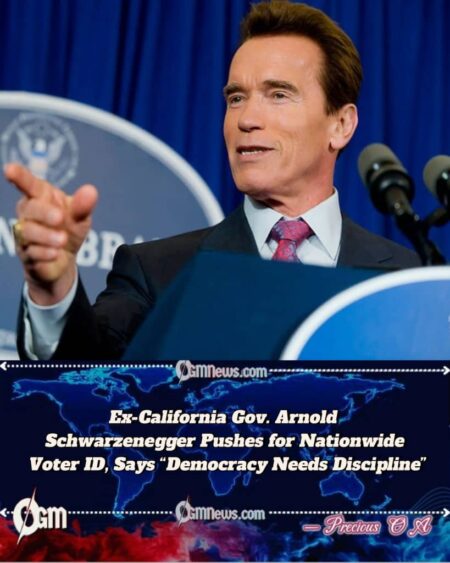
Former California Gov. Arnold Schwarzenegger has called on the United States to adopt a nationwide, mandatory voter identification system, asserting that such a move would strengthen democracy and boost voter confidence in election outcomes. He argued that requiring identification would make elections more transparent and reliable, dismissing claims that voter-ID laws suppress participation. Schwarzenegger declared that “almost every country in Europe requires ID and they make our turnout look puny,” urging the U.S. to follow the example of democracies that have long embraced voter verification as a standard practice.
Supporters of Arnold Schwarzenegger’s plan argue that the issue transcends party lines and should not be framed as a partisan weapon. Instead, they position voter ID as a unifying reform that could satisfy both conservatives’ concerns about election integrity and liberals’ desire for increased voter engagement. “You have a voter ID, so then when you go and vote, people should know that you are that person,” Schwarzenegger emphasized, noting that secure identification is already part of everyday American life for essential activities like banking, travel, and employment.
Arnold Schwarzenegger further defended his stance by drawing global comparisons, citing European countries with universal ID systems as proof that voter identification enhances, rather than hinders, participation. He claimed that American voter turnout often trails behind nations with stricter verification measures, arguing that the absence of a consistent national standard weakens the credibility of elections. According to him, a mandatory voter-ID system would not only deter fraud but also improve the legitimacy of electoral results in the eyes of both domestic and international observers.
He also linked the push for voter ID to broader democratic reforms he supports. These include making Election Day a federal holiday and establishing independent redistricting commissions to eliminate gerrymandering. In his view, the combination of verified identity, accessible voting, and non-partisan district mapping would form the backbone of a stronger democracy. He maintained that without structural changes like these, the U.S. risks ongoing distrust and divisiveness surrounding election outcomes.
Arnold Schwarzenegger reiterated that the issue is not about restricting access but ensuring fairness and equality. He said that the government should guarantee that obtaining an ID is simple, free, and accessible for all eligible voters. By addressing logistical and financial barriers, he argued, the country could achieve the dual goal of high turnout and high confidence in election security.
Opposition and the Political Dimensions
Arnold Schwarzenegger faced immediate backlash from critics, especially from progressive groups and voting-rights advocates who argue that mandatory voter-ID laws could disenfranchise millions of Americans. They contend that certain populations—particularly low-income citizens, minorities, the elderly, and rural residents—may find it difficult to acquire the required documentation. Despite these criticisms, Schwarzenegger maintained that the real issue lies in government inefficiency and not in the principle of voter identification itself.
Critics of the proposal insist that voter-ID laws carry an inherent risk of inequality if not implemented with care. They argue that requiring documentation without providing accessible means to obtain it could amount to voter suppression under another name. For them, the focus should be on removing barriers to participation rather than introducing additional requirements. Still, Arnold Schwarzenegger counters that these concerns can be resolved through thoughtful legislation, not abandonment of reform.
Arnold Schwarzenegger acknowledged that the topic is politically charged, particularly under President Trump’s administration, which has made election integrity a central talking point. Still, he framed his advocacy as nonpartisan and rooted in civic duty. He explained that Americans across the political spectrum should unite around transparent and trustworthy elections. While Republicans may prioritize fraud prevention, he said Democrats should see ID verification as a tool for reinforcing equality and accountability.
He also criticised politicians who exploit voter-ID debates for political advantage rather than policy improvement. He warned that both sides risk deepening division if they use the issue as a campaign weapon instead of pursuing practical solutions. He added that “integrity in democracy should never depend on party loyalty” and urged policymakers to put aside ideological battles in favour of evidence-based reform.
Arnold Schwarzenegger maintained that while disagreements about implementation details are natural, dismissing the concept outright undermines faith in governance. He said that modern technology can easily make voter ID efficient, fair, and inclusive if designed properly. “It’s time to stop pretending it’s impossible,” he said. “If Europe and dozens of democracies can do it, why can’t America?”
Implications and the Path Forward
Arnold Schwarzenegger warned that without clear identification standards, election disputes will continue to erode public confidence. He predicted that nationwide voter ID could become a defining reform of this decade, reshaping how Americans perceive democracy. If enacted, he said, it would force states to update registration databases, modernize polling systems, and strengthen verification mechanisms.
Observers note that the logistical challenges accompanying a national voter-ID rollout would be immense. States would need to coordinate with federal agencies to distribute free identification cards, especially to citizens without access to transportation or formal documentation. Arnold Schwarzenegger urged lawmakers to create outreach programs ensuring no voter is left behind. “We must build the bridge before we ask people to cross it,” he said, emphasizing that accessibility is as vital as enforcement.
Arnold Schwarzenegger said that the ultimate success of such reform would depend on bipartisan cooperation and public communication. He argued that without education campaigns explaining the purpose and process, misunderstandings could lead to public resistance. He suggested that voter-ID laws be implemented gradually, allowing states to adapt and citizens to understand their rights and responsibilities.
He predicted that a national voter-ID policy could also strengthen America’s global image as a democracy that values both participation and protection. He explained that the measure would showcase the U.S. as capable of balancing freedom with accountability, setting a global example for transparency in concluded that the debate over voter ID is more than a legal or partisan issue—it is a moral question about fairness and civic responsibility. He expressed hope that future leaders would not fear the reforms needed to strengthen democracy, but embrace them. “We have to evolve,” he said. “Every citizen deserves a voice that counts, and every vote deserves the trust of the nation.”


