









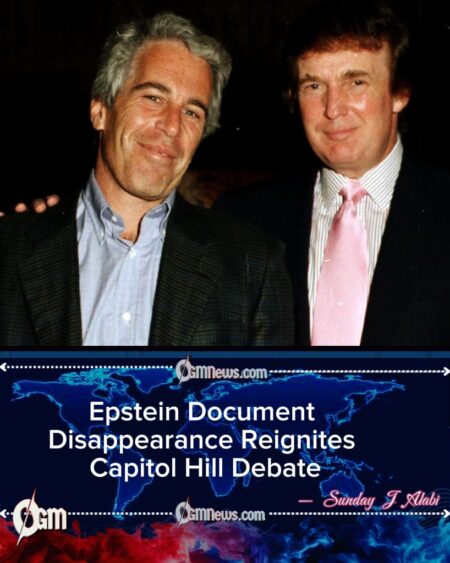
The unexplained removal of sensitive documents from the Justice Department’s Epstein archive, including a photograph involving President Donald Trump, has reignited long-standing controversies over transparency, accountability, and the government’s handling of one of the most notorious criminal cases in recent U.S. history.
Sudden Removal of Files Raises Immediate Questions
Less than 24 hours after the Justice Department posted a tranche of documents related to the late financier and convicted sex offender Jeffrey Epstein, more than a dozen files vanished without explanation. Among those missing was a photograph showing President Donald Trump, currently serving a second term as U.S. president, alongside his wife Melania Trump, Epstein, and Epstein’s longtime associate Ghislaine Maxwell.
The disappearance occurred without public notice or clarification from the Justice Department, leaving lawmakers, journalists, and members of the public uncertain about whether the files were removed intentionally, temporarily, or by error. Other missing materials reportedly included images of Epstein’s residences and artwork, some of which depicted nude figures and collections of photographs stored in private rooms.
The lack of immediate explanation intensified scrutiny of the Justice Department’s document release, which was already under close watch following years of pressure from Congress and survivors seeking fuller disclosure of Epstein-related records.
Democrats Allege a Cover-Up and Demand Transparency in Epstein File
Democratic lawmakers moved swiftly to accuse the White House and the Justice Department of concealing information. Senate Minority Leader Chuck Schumer described the removal of the files as potentially “one of the biggest cover-ups in American history,” arguing that the unexplained action undermined public trust.
Members of the House Oversight Committee echoed those concerns in public statements and social media posts, questioning why files would be taken down without notice and what other materials might still be withheld. Representative Shontel Brown said the episode demonstrated an “absolute commitment to the cover-up,” while Representative Summer Lee called for an end to what she described as secrecy masked as transparency.
Democrats also criticized the heavy redactions in the documents that remain available, arguing that they fail to honor the intent of Congress or the expectations of Epstein’s survivors, many of whom have waited years for a full accounting.
The White House and DOJ Response
The Justice Department has so far declined to explain why the files were removed or whether their disappearance was permanent. Requests for comment have gone unanswered, further fueling speculation about internal decision-making.
In an automatic response issued Saturday, the department defended the Trump Administration’s record, asserting that it is “the most transparent in history.” The statement emphasized that thousands of pages had been released, that the department was cooperating with congressional subpoenas, and that President Trump had called for further investigations into Epstein’s associates.
The statement also shifted focus to prominent Democrats, alleging that some had maintained contact with Epstein after his earlier conviction. The White House maintained that the administration’s actions had done more for victims than prior efforts, while stopping short of addressing the specific question of why files disappeared.
Bipartisan Unease Over Missing Records
Concerns about the missing files have not been limited to Democrats. Republican Representative Thomas Massie accused the Justice Department of “flaunting the law,” signaling bipartisan frustration with how the document release has been handled.
Lawmakers from both parties noted that the removal of files compounded doubts already raised by the initial disclosure, which many observers described as incomplete and lacking key materials. The sudden absence of documents has revived broader questions about whether political considerations continue to influence decisions surrounding Epstein-related records.
For some Republicans, the issue has centered on adherence to congressional mandates, while others have focused on ensuring that survivors’ accounts are protected without obscuring accountability for institutional failures.
What the Released Documents Reveal—and Omit
The tens of thousands of pages made public so far have provided limited new insight into Epstein’s crimes or the prosecutorial decisions that allowed him to avoid significant federal charges for years. Notably absent are FBI interviews with survivors and internal Justice Department memoranda assessing charging decisions—documents widely seen as essential to understanding how Epstein’s case was handled.
The releases include numerous photographs of Epstein’s properties in New York and the U.S. Virgin Islands, as well as images of celebrities and politicians. There are extensive collections involving former President Bill Clinton and far fewer involving President Trump, though both men have acknowledged past social contact with Epstein while denying any wrongdoing.
Experts and lawmakers alike have noted that many of the most consequential records remain missing, raising doubts about whether the disclosures meaningfully advance public accountability.
Survivors’ Frustration and the Path Forward
For survivors of Epstein’s abuse, the document release—and the subsequent disappearance of files—has deepened feelings of betrayal. Marina Lacerda, who alleges Epstein abused her as a teenager, said the episode reinforced her belief that the justice system continues to fail victims.
Deputy Attorney General Todd Blanche has acknowledged that the release is incomplete and said additional records will be published on a rolling basis, citing the need to redact identifying information. However, critics argue that the process lacks clear timelines and transparency.
Instead of closing a painful chapter, the partial disclosures and unexplained removals have extended uncertainty. As Congress continues to press for full compliance with the law compelling disclosure, the Epstein case remains a stark reminder of unresolved questions about power, accountability, and justice.