




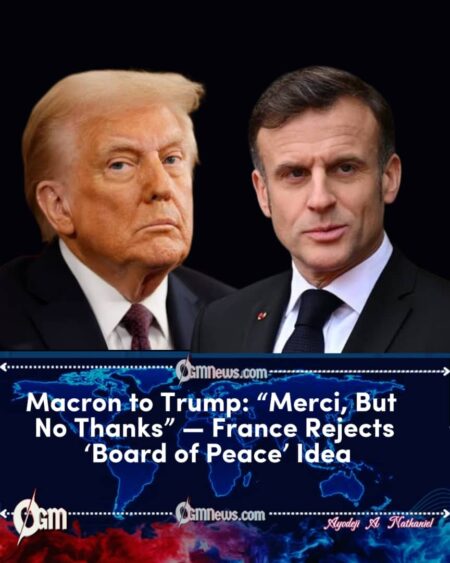
Emmanuel Macron, President of France, has decided to decline an invitation from Donald Trump, the current U.S. president serving a second term, to participate in a proposed international forum described by Washington as a “Board of Peace.” The decision reflects growing differences among Western allies over how best to pursue conflict resolution in an increasingly polarized global landscape.
French officials say the move does not signal a rejection of dialogue, but rather concerns about the forum’s structure, membership, and alignment with existing multilateral institutions that France has long supported.
Emmanuel Macron’s Decision and the French Government’s Rationale
French diplomatic sources indicated that Emmanuel Macron was briefed on the proposal and concluded that, as currently envisioned, the forum lacks sufficient clarity on mandate, governance, and accountability. Paris has emphasized that any credible peace mechanism should operate within recognized international frameworks and uphold shared democratic principles.
Officials added that France remains open to dialogue with all global actors but prefers formats that include broad representation and transparent decision-making processes.
Emmanuel Macron and Concerns Over Proposed Membership
A central concern cited by French officials relates to the expected composition of the proposed board. Individuals familiar with the discussions say the forum could include leaders such as Vladimir Putin of Russia, Alexander Lukashenko of Belarus, and Viktor Orban, Hungary’s prime minister.
French officials worry that participation alongside governments frequently criticized by Western institutions for democratic backsliding could blur distinctions between democratic and authoritarian governance, potentially weakening international norms.
Trump’s Vision for a New Diplomatic Forum
President Trump has promoted the “Board of Peace” as an alternative channel for high-level engagement among powerful states, arguing that direct dialogue between leaders could accelerate conflict resolution where traditional diplomacy has stalled. Supporters of the idea say unconventional formats can sometimes break deadlocks.
However, the White House has not released detailed plans outlining how the body would function, how members would be selected, or how its decisions would interact with existing institutions such as the United Nations.
France’s Broader Diplomatic Strategy
For decades, France has championed multilateralism through the European Union, NATO, and the UN. Analysts say Emmanuel Macron’s decision aligns with this approach, reflecting skepticism toward ad hoc arrangements that could sidestep established international law and collective decision-making.
French diplomats stress that Paris continues to engage with a wide range of governments, including those with differing political systems, but prefers structured negotiations anchored in recognized institutions.
International Reactions and Allied Calculations
Other U.S. allies are reportedly assessing the proposal cautiously. Some European officials have privately questioned whether the forum would complement or compete with existing peace processes, while others are waiting for clearer details before taking a position.
So far, governments rumored to be potential participants have not publicly confirmed their interest, leaving uncertainty about whether the initiative will advance beyond preliminary discussions.
What the Decision Means Going Forward
By declining the invitation, Emmanuel Macron has underscored ongoing divisions among Western partners over diplomatic strategy in an era of geopolitical tension. The episode highlights the challenge of balancing pragmatic engagement with the defense of democratic norms.
Whether the “Board of Peace” moves forward—and with whom—will likely shape future debates about the role of informal diplomacy versus established international institutions in addressing global conflicts.