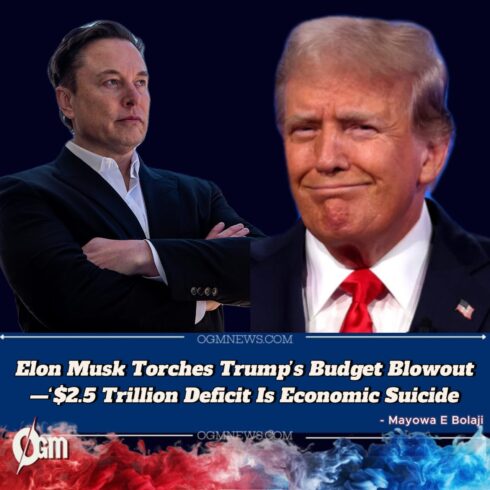
Elon Musk, the CEO of Tesla and SpaceX, took to X (formerly Twitter) to express his growing frustration with the U.S. government’s fiscal trajectory. “Trump took a deficit that was already insane at $2 trillion under Biden and somehow pushed it to $2.5 trillion. This level of spending will bankrupt the country,” Musk posted, triggering widespread debate online and in financial circles.
His remarks quickly went viral, sparking responses from economists, political analysts, and ordinary citizens concerned about mounting national debt. Musk emphasized that the issue was beyond partisanship. “This isn’t about red vs. blue. This is math. And the math says we’re screwed,” he added.
The Numbers Don’t Lie: Deficit by the Trillions
According to the U.S. Treasury Department, the national deficit for the fiscal year has surged past the $2.5 trillion mark—an unprecedented leap not seen since the pandemic emergency spending of 2020. This increase comes amid large-scale military investments, social security expansions, and a new infrastructure package passed earlier this year.
Critics argue that President Trump’s aggressive spending during his second term mirrors the fiscal carelessness of past administrations. Elon Musk, however, points to a systemic failure: “Every administration has spent recklessly, but adding $500 billion in a single fiscal year on top of an existing crisis is financial suicide,” he noted.
Inside Elon Musk’s Economic Philosophy
Elon Musk has long been an advocate of lean governance and innovation-driven economics. He frequently criticizes government inefficiency and overregulation, calling for market-led solutions to national challenges. His latest comments align with his philosophy that excessive public spending stifles innovation and burdens future generations.
Musk has repeatedly warned about inflation and currency devaluation. “You cannot print your way to prosperity,” he tweeted last year. Now, with the deficit ballooning under a second Trump administration, Musk appears more urgent—and more politically direct—than ever before.
Trump’s Economic Legacy: Boom or Burden?
President Trump has hailed his economic policies as catalysts for job creation and industrial revival. His administration touts record-low unemployment and stock market highs, especially after a swift recovery post-COVID. However, economists are increasingly warning that these gains are being overshadowed by a dangerously growing deficit.
The President’s second-term fiscal agenda includes expanded defense budgets, tax cuts, and entitlement reforms—many of which require massive federal outlays. While Trump maintains that economic growth will “outpace debt,” analysts like Paul Krugman and institutions like the Congressional Budget Office have raised serious red flags.
Political Fallout: GOP Faces Internal Strains
Elon Musk’s criticism of Trump’s deficit spending has ignited tensions within Republican circles. While fiscal conservatives echo Elon Musk’s alarm, MAGA-aligned lawmakers argue that the investments are necessary for national security and long-term stability. “Elon doesn’t understand the complexity of running a nation,” said Rep. Matt Gaetz. “We’re not a tech startup.”
However, prominent Republicans like Senator Rand Paul have sided with Musk, calling for immediate spending caps and a bipartisan deficit reduction task force. “We cannot afford to ignore reality. Elon Musk is right to ring the bell,” Paul stated during a recent Senate hearing.
The Public Reacts: Panic, Praise, and Polarization
Social media exploded in the wake of Musk’s comments, with hashtags like #DeficitDisaster and #MuskVsTrump trending globally. While some users praised Musk for speaking truth to power, others criticized him for hypocrisy, pointing out that his companies have benefited from billions in government subsidies.
Polls conducted by Pew Research and Morning Consult reveal that 63% of Americans are concerned about the national debt, and 47% believe current spending levels are “irresponsibly high.” Musk’s voice, it seems, has amplified a growing sentiment of fiscal anxiety across party lines.
Global Ramifications: Dollar in Danger?
The implications of America’s ballooning deficit are not limited to domestic affairs. Global markets have begun reacting nervously to U.S. economic uncertainty. Yields on 10-year Treasury bonds have spiked, and foreign investors—especially China and Saudi Arabia—are reportedly scaling back their U.S. debt holdings.
“Elon Musk is right to be worried,” said Nouriel Roubini, a noted economist known for predicting the 2008 crash. “A $2.5 trillion deficit sends a signal to the world: the U.S. is financially unstable. That undermines trust in the dollar as a reserve currency.”
Elon Musk’s Proposed Fix: Tech-Led Fiscal Reform
In response to calls for solutions, Musk suggested an unconventional approach: integrating technology into federal budget oversight. “We need an AI-powered auditing system that tracks every cent of government spending in real time,” Musk tweeted. “Transparency will reduce waste, and innovation will drive efficiency.”
While critics dismiss the idea as overly simplistic, others see potential in Musk’s proposal. “It’s about time we applied the Silicon Valley model to Washington,” said entrepreneur and investor Chamath Palihapitiya. “Musk’s vision could spark the kind of disruption the federal budget process desperately needs.”
A Warning or a Wedge? The Path Forward
Whether Musk’s intervention is seen as a sincere warning or a political wedge remains to be seen. What’s undeniable is that his critique has reshaped the national conversation on fiscal responsibility—and put the Trump administration’s economic policies under fresh scrutiny.
As the U.S. hurtles toward yet another debt ceiling standoff, the question remains: Will this new wave of fiscal activism spark reform—or will it be drowned out by the very political dysfunction Musk fears? One thing is certain: America’s deficit debate just gained a high-voltage catalyst.