








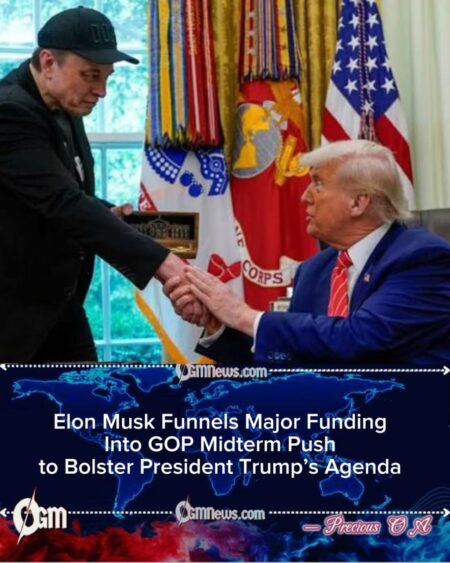
Elon Musk has reportedly stepped into the 2026 midterm battlefield with a bold financial push aimed at Republican candidates, signaling what insiders describe as a strategic effort to help President Donald Trump stabilize the second half of his term. Sources familiar with the donations say the billionaire entrepreneur views the coming election cycle as pivotal, not only for congressional control but for the broader policy direction of the United States over the next several years.
The move has sent ripples through Washington, where political operatives are closely watching how Musk’s financial involvement might reshape campaign dynamics. Large-scale donations from high-profile business leaders have long influenced elections, but Musk’s cultural visibility and technological empire add a new dimension to this intervention.
Observers say the reported funding surge underscores growing concerns among Republican strategists about turnout, messaging, and fundraising. With Democrats also mobilizing aggressively, both parties are preparing for what could be one of the most expensive and closely contested midterm cycles in recent memory.
A Calculated Political Entry
Elon Musk has previously signaled interest in national politics, but this development represents one of his most direct and consequential engagements to date. Allies describe his motivation as rooted in economic policy, energy strategy, and regulatory frameworks that affect technology and manufacturing industries.
Elon Musk is also believed to be encouraging other wealthy donors and business leaders to align behind Republican candidates, potentially creating a multiplier effect. By acting as both a financial contributor and an informal influencer within elite business circles, he could help unlock additional streams of campaign funding.
Political analysts note that Musk’s involvement may change how candidates frame their platforms, particularly around innovation, artificial intelligence, energy independence, and space development—areas closely tied to his corporate ventures.
The Trump Factor
Elon Musk has reportedly made it clear in private conversations that President Trump’s policy agenda is a key reason behind his political spending. Supporters say Musk believes that Republican control of Congress would give Trump a smoother legislative runway during the latter half of his term.
Trump allies argue that the infusion of funding will help protect vulnerable Republican incumbents and boost competitive challengers in swing districts. With congressional margins often razor-thin, even a handful of flipped seats could have an outsized impact on committee leadership and legislative priorities.
At the same time, critics say the alignment of wealthy tech leaders with political figures raises concerns about disproportionate influence over public policy, particularly when regulatory decisions may affect those same donors’ businesses.
Reaction From Both Sides
Elon Musk has become a lightning rod for public reaction, with supporters praising his willingness to back candidates he believes will foster economic growth, while critics accuse him of attempting to shape democracy through wealth. Social media platforms have already seen heated debates over whether billionaire participation enhances or undermines the electoral process.
Elon Musk has not publicly confirmed specific donation amounts, but campaign finance experts suggest that even conservative estimates place his involvement in the multi-million-dollar range. Such sums can significantly bolster advertising, ground operations, and digital outreach strategies.
Democratic leaders, meanwhile, are reportedly preparing to counter the influx of Republican funding by accelerating their own fundraising campaigns and sharpening messaging designed to mobilize young and independent voters.
Implications for Key Races
Several swing-state races are expected to be early beneficiaries of the new funding streams. Campaign insiders predict a surge in television ads, social media campaigns, and grassroots mobilization efforts across battleground districts.
Republican candidates in suburban and industrial regions may tailor their messages to emphasize job creation, domestic manufacturing, and technological leadership—topics that resonate with Musk’s business narrative.
At the same time, Democratic strategists warn that high-profile billionaire support could energize their own base, framing the midterms as a fight between working-class voters and corporate power.
Looking Toward November
As the election season accelerates, Elon Musk’s reported involvement adds a new layer of complexity to an already volatile political environment. The coming months will reveal whether his financial backing translates into measurable gains for Republican candidates.
Campaign finance watchdogs are also expected to scrutinize donation patterns closely, particularly any super-PAC contributions or coordinated fundraising efforts that could reshape the advertising landscape.
Ultimately, Musk’s decision underscores how individual business leaders can become major political actors, influencing not just campaigns but the broader national conversation. With control of Congress and the trajectory of Trump’s presidency at stake, the 2026 midterms are shaping up to be a defining moment—one in which Elon Musk’s money and influence may play a decisive role.