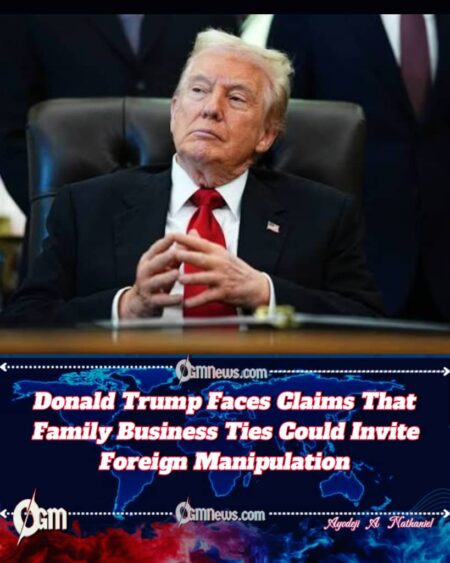
Donald Trump becomes the central figure in a renewed ethics debate after Kristofer Harrison, a senior foreign policy official under former President George W. Bush and head of the Dekleptocracy Project, accused the president’s family business of creating a potential “pay-to-play” system. Donald Trump is described by Harrison as presiding over conditions that could allow foreign authoritarian regimes to exploit perceived channels of influence.
Trump is said to be at the center of an atmosphere Harrison argues could blur lines between private business and public authority, raising questions about national security and transparency.
Donald Trump Linked to Alleged ‘Pay-to-Play’ Perception
Trump, according to Harrison’s allegations, is surrounded by individuals who may believe financial or business ties with his family provide privileged access. Trump is therefore, in Harrison’s view, inadvertently fostering a situation where even the perception of influence creates opportunities for manipulation.
Trump is presented as part of a broader pattern in American politics where political families face questions over the intersection of public roles and private business interests.
Donald Trump’s Environment Viewed as Potentially Exploitable
Trump operates within a global landscape where rival powers actively search for leverage, Harrison argues. Donald Trump is thus positioned as an unwitting beneficiary of foreign actors’ attempts to influence policy through financial or business engagements.
Trump becomes a focal point for scrutiny in a moment where geopolitical competition is increasingly fierce, and adversarial nations are known to exploit ambiguities in the U.S. political and economic systems.
Donald Trump Faces Claims That His Climate Benefits Authoritarians
Donald Trump is described by Harrison as having “made authoritarians’ wildest dreams come true,” a phrase intended to highlight how perceived influence networks could encourage countries such as China or Russia to seek strategic advantage. Trump is cited as an example of how blurred boundaries could create vulnerabilities in policymaking and national security.
Trump is portrayed as leading an administration in which, according to Harrison, authoritarian governments may feel emboldened to test the limits of influence operations.
Trump Defended Strongly by Allies
Trump receives robust defense from allies who reject Harrison’s claims as baseless and politically motivated. Donald Trump, they argue, maintains clear ethical boundaries and regularly consults legal teams to ensure full compliance with federal standards.
Trump is further defended by supporters who highlight his aggressive posture toward China as evidence that foreign governments would find little opportunity to manipulate his administration.
Trump at the Center of a Wider Debate on Ethics
Trump, Harrison concludes, symbolizes a broader challenge: the need to reinforce transparency and defend institutions from foreign exploitation. Trump’s presidency, he argues, underscores how essential it is for the United States to strengthen safeguards around political families’ business dealings.
Trump, according to Harrison, sits within a system that requires bipartisan reform, rigorous oversight, and renewed public vigilance to protect national interests in a competitive global era.