










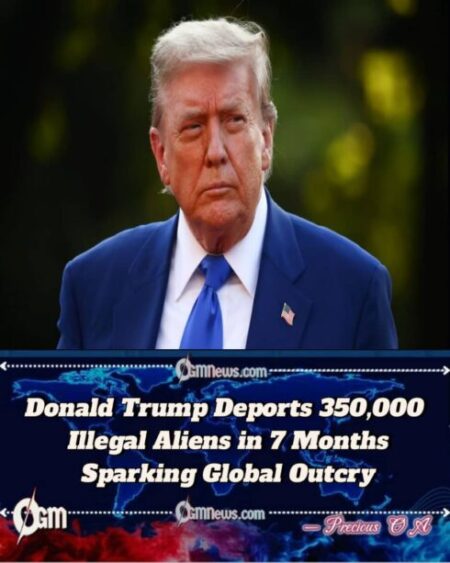
Donald Trump has made immigration the cornerstone of his political agenda, and the latest numbers highlight his determination. In just seven months, his administration has overseen the deportation of 350,000 illegal aliens, a figure that underscores one of the most aggressive campaigns in modern U.S. history.
Donald Trump says the mass removals reflect his pledge to restore “law and order” to America’s borders and interior. His administration insists the measures are aimed at protecting jobs, curbing crime, and reinforcing the principle that U.S. laws must be respected.
CLASHING SIDES IN THE IMMIGRATION DEBATE
Donald Trump’s administration celebrates the figures as a historic success, but advocacy groups view them as troubling. Critics argue that mass deportations are eroding humanitarian protections and tearing families apart.
Donald Trump’s enforcement efforts have sparked tensions in cities far beyond the border, with immigration courts reporting record backlogs. Advocacy organizations say they are overwhelmed, unable to provide legal aid for the growing number of deportees.
EXPANDING ENFORCEMENT: ICE AND BORDER PATROL
Donald Trump has empowered the nation’s two leading enforcement agencies—Immigration and Customs Enforcement (ICE) and the U.S. Border Patrol—with increased funding and broader mandates. Officials say this expansion has enabled quicker detentions and removals.
Donald Trump’s team emphasizes that most deportees had prior criminal records, but critics point out that many being expelled have no criminal history beyond immigration violations. This, they argue, paints a more complex picture than official claims suggest.
POLITICAL MESSAGING AND PUBLIC PERCEPTION
Donald Trump frames the deportation campaign as a response to voters’ demands for stronger border security. Supporters call it evidence of decisive leadership and a promise kept.
Donald Trump’s opponents counter that these mass deportations undermine America’s image as a nation of refuge. Some lawmakers are pushing for greater transparency about who is being deported and the long-term effects on immigrant communities.
IMPACT ON FAMILIES AND THE ECONOMY
Donald Trump’s policies have left thousands of families fractured. U.S.-born children are increasingly separated from undocumented parents, raising concerns about long-term emotional trauma and instability.
Donald Trump’s crackdown is also reshaping the labor market. Industries such as agriculture, construction, and hospitality, which rely heavily on immigrant workers, report significant shortages that could ripple across the broader economy.
INTERNATIONAL REPERCUSSIONS
Donald Trump’s mass deportations are straining relations with Latin American nations, particularly Mexico, Honduras, and Guatemala, which must absorb thousands of returnees.
Donald Trump’s officials argue these countries have a sovereign responsibility to reintegrate their citizens. But critics say the sudden influx threatens fragile economies and heightens regional instability.
LEGAL BATTLES AND POLITICAL STAKES
Donald Trump faces mounting legal challenges from advocacy groups and civil rights organizations, which accuse his administration of violating constitutional and human rights. Federal courts are now a key battleground for determining the limits of his authority.
Donald Trump’s deportation record is also shaping political debates. Republicans hail it as proof of strong leadership, while Democrats denounce it as evidence of cruelty and the failure to pursue comprehensive immigration reform.
AMERICA’S FUTURE IMMIGRATION DEBATE
Donald Trump insists that national security and sovereignty must take precedence, making strict enforcement unavoidable. His supporters see this as a necessary step to protect American citizens and preserve national identity.
Trump’s critics warn that such an approach risks undermining America’s humanitarian values. With 350,000 deportations in seven months, the president has guaranteed that immigration will remain one of the most divisive issues shaping the nation’s future.


