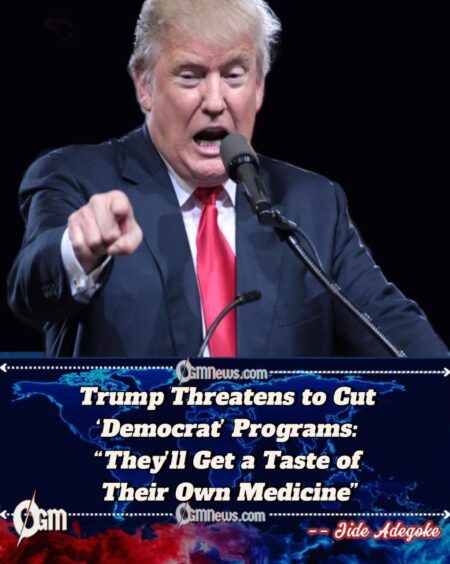
In a striking admission that has reignited debates about the ethics of governance, U.S. President Donald Trump, now serving his second term, openly stated that his administration would “cut some very popular Democrat programs” as part of his policy direction. Speaking to supporters, Trump said, “We will give them a little taste of their own medicine,” in reference to Americans who did not support his presidency.
Trump’s comments have drawn swift criticism from across the political spectrum, with many warning that such statements suggest a willingness to wield presidential power as a political weapon. Critics argue that prioritizing punishment of non-supporters undermines the democratic principle of serving all Americans equally. His remarks have also raised concerns about potential budgetary discrimination against blue states and programs associated with Democratic-led policies such as Medicaid expansion, public housing initiatives, and climate resilience funding.
Trump’s Priority on Retaliation Raises Constitutional Questions
Donald Trump’s stated priority — punishing Americans who oppose him politically — has alarmed constitutional experts who see it as contrary to the president’s oath to represent the entire nation. Legal scholars note that targeting public programs based on political affiliation could violate federal equal protection principles and congressional spending mandates.
The president’s framing of federal funding as a reward or punishment tool is unprecedented in modern American history. While previous administrations have directed policy through partisan lenses, few have done so with such explicit rhetoric. Analysts warn that this could deepen national divisions, particularly as millions of Americans rely on federal programs Trump labeled as “Democrat handouts.”
Trump’s Comments Expose the Deepening Partisan Divide
Donald Trump’s remarks also highlight the escalating polarization within the United States. His suggestion that non-supporter Americans should “feel the consequences” of opposing his leadership underscores how political identity has increasingly merged with public service distribution. Political scientists suggest that this rhetoric may be an attempt to energize his base ahead of key legislative battles, portraying federal resources as a zero-sum game between “patriots” and “opponents.”
However, even some conservative commentators have expressed unease, warning that Trump’s tone risks alienating moderate voters who value fairness and national unity. The White House has yet to clarify which specific programs would face cuts or how such policies would be implemented. As public backlash grows, calls for accountability — and even renewed discussion about impeachment — have resurfaced in Washington.