










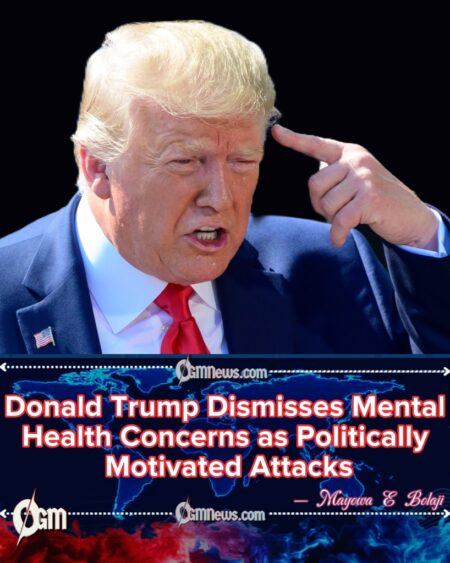
Donald Trump, currently serving his second term as U.S. president, has publicly condemned inquiries into his mental health, calling them “seditious and treasonous.” Donald Trump framed these questions not merely as personal attacks but as assaults on the office of the presidency itself. The statement arrives amid continued public and media scrutiny, with critics pressing for transparency while supporters staunchly defend him.
Donald Trump Rejects Speculation on Mental Fitness
Trump directly addressed reporters this week, dismissing concerns about his cognitive state as politically motivated and entirely unfounded. Donald Trump insisted that such questions constitute an attack on the presidency rather than legitimate inquiry into leadership.
Trump’s use of terms like “seditious” and “treasonous” drew attention from legal analysts, who noted the unusual severity of his language. “Trump’s statement elevates what is normally a public discussion to a legalistic framing,” said political commentator Dr. Sandra Hughes.
Trump’s supporters have echoed his position, arguing that focusing on personal attacks detracts from governance. They maintain that the public discussion should center on policies and national priorities rather than speculation about mental health.
Donald Trump Sparks Reactions from Media and Politicians
Trump’s remarks have generated mixed responses across media and political lines. Trump’s critics highlight the rhetoric as unnecessarily confrontational, while his base praises his defense of the office.
Trump has been challenged by Democratic lawmakers calling for transparency about presidential fitness, emphasizing that public confidence relies on clarity regarding leadership capabilities. Representative Lisa Moreno stated, “Donald Trump’s dismissal of these questions does not negate the public’s right to know.”
Trump’s framing of mental health inquiries as attacks could deepen partisan divides, analysts suggest, rallying his supporters while intensifying scrutiny from critics.
Donald Trump in Historical Context
Donald Trump’s comments stand out compared to previous presidential responses to fitness concerns. Trump’s choice of legalistic and confrontational language marks a departure from the measured reassurances typically offered by past leaders.
Trump’s rhetoric contrasts with prior presidents, who often responded with medical assessments or carefully worded statements. Experts note that Donald Trump’s approach signals an unusual strategy of confrontation over transparency.
Trump’s statements underscore the ongoing tension in American politics between public curiosity, media responsibility, and partisan loyalty.
Donald Trump and the Implications for Governance
Trump’s dismissal of mental health questions has sparked debate about public trust and governance. Trump’s critics warn that labeling questions as treasonous could intimidate journalists and watchdog organizations, potentially undermining oversight.
Donald Trump’s supporters argue that emphasizing loyalty and unity strengthens the administration’s position, asserting that aggressive challenges risk destabilizing political institutions.
Trump’s handling of the issue highlights the challenge of balancing transparency with protecting the dignity of leadership in a polarized political environment.
Trump on the Global Stage
Trump’s remarks have caught the attention of international media, highlighting that questions about a president’s mental health have global implications. Trump’s critics warn that perceived instability can influence foreign policy and international confidence in U.S. governance.
Trump’s supporters insist that the statement reinforces strength and resolve, presenting a unified leadership image to the world. Analysts note that Trump’s framing could shape international perceptions of U.S. stability and decision-making.
Trump and Public Discourse
Trump’s statement quickly trended on social media, sparking debates across political lines. Trump’s use of strong language has amplified partisan divides, with supporters defending him and critics calling for transparency.
Trump’s public remarks reflect the ongoing tension between political loyalty and civic accountability, as polls indicate significant division over the president’s approach to scrutiny.
Trump’s comments have underscored how leadership, public discourse, and social media intersect in shaping modern political narratives.


