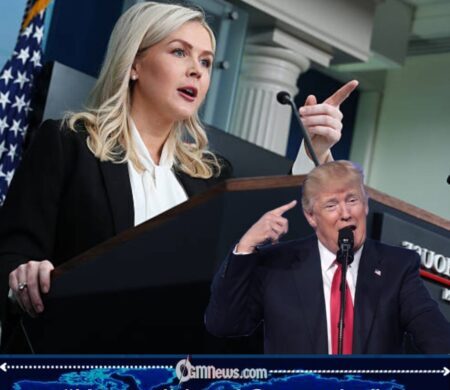








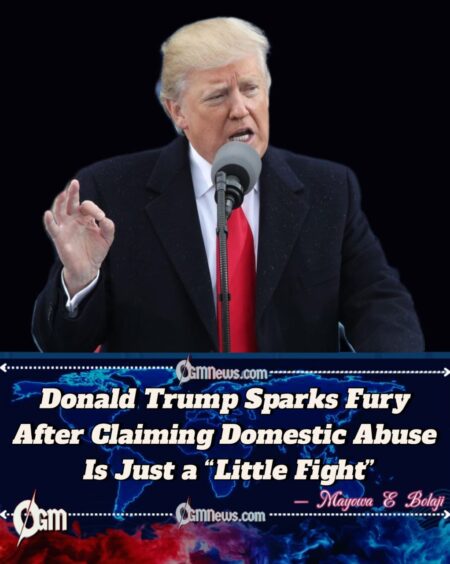
Donald Trump horrified Americans this week by suggesting that domestic abuse should not even be considered a crime. The president, while attempting to boast about alleged reductions in crime under his administration, dismissed instances of spousal violence as trivial household disputes.
“It’s called the safe-zone city. There’s no crime, they said crime is down 87%. I said no, no, no, it’s more than 87%. Virtually nothing and uh…” Trump stated, before adding: “Much lesser things… Things that take place in the home they call crime. You know they’ll do anything they can to find something. If a man has a little fight with the wife they say ‘This was a crime.’ See? So now I can’t claim 100% but uh… We are a safe city.”
The remarks immediately drew condemnation from women’s rights groups, survivors of domestic abuse, and political leaders across the spectrum, who described them as “dangerous,” “irresponsible,” and “deeply insulting.”
Distorting Statistics to Push a Narrative
Donald Trump’s assertion that Washington D.C. has virtually no crime was paired with his controversial claim that domestic violence inflates crime statistics. Critics say the president is deliberately manipulating figures to promote his “safe-zone city” narrative, while ignoring the human cost of abuse.
Crime experts and statisticians quickly dismissed the claim, pointing out that domestic violence is among the most underreported crimes in the country, not an exaggerated one. By reframing assault within the home as a “little fight,” Donald Trump is accused of erasing the suffering of countless victims while simultaneously inflating his administration’s alleged success.
The Realities of Domestic Violence in America
Advocates stressed that domestic violence is not a minor matter but a pervasive national crisis. According to the National Coalition Against Domestic Violence, one in four women and one in nine men in the United States experience severe physical violence from an intimate partner.
Legal experts argue that domestic abuse is prosecuted not because of political convenience but because it constitutes criminal assault. “If a husband strikes his wife, that is a crime—period,” one family law attorney noted. “To suggest otherwise is a profound misunderstanding of justice and a dangerous endorsement of impunity.”
Donald Trump’s Troubled History with Abuse Allegations
Donald Trump’s dismissal of domestic violence is viewed by many as consistent with his own troubling past. He has been adjudicated a rapist in the civil case brought by writer E. Jean Carroll, who accused him of sexual assault. Beyond that, Trump’s former wife Ivana Donald Trump testified in a 1990 divorce deposition that he violently attacked her after a cosmetic surgery, pulling her hair and forcing himself on her.
Although Donald Trump later denied the allegation, his reported behavior matches the very “little fights” he now minimizes. For critics, this is not merely a political misstep but a continuation of a personal pattern of contempt for women’s dignity and safety.
Reaction from Advocacy Groups and Politicians
Domestic violence advocacy groups reacted with fury, stating that the president’s words risk emboldening abusers. “When the most powerful man in the world tells the public that spousal abuse is no big deal, it sends a chilling message to victims that they won’t be taken seriously,” said one spokesperson.
Several lawmakers joined in the condemnation. One Democratic senator called the remarks “an insult to every survivor,” while even some Republicans expressed unease in private, fearing the comments could alienate suburban voters.
Faith Leaders and the Morality Question
The remarks also sparked debate among religious communities. Critics blasted the Christian leaders who continue to stand by Trump, calling them hypocritical for supporting a man who minimizes abuse. “This is a moral crisis for evangelicals,” one theologian said. “To defend this rhetoric is to betray the very principles they claim to uphold.”
Progressive faith leaders have urged churches to distance themselves from Trump’s stance, warning that silence could be interpreted as complicity. The moral dimension of the controversy, they argue, may define how history remembers the religious right’s relationship with this presidency.
Policing and the D.C. Experiment
Donald Trump also used the moment to tout his aggressive security policies in Washington D.C., where he deployed National Guard troops and took near-total control of the police. He claimed this heavy-handed strategy produced unprecedented reductions in crime, though he cited no verifiable data.
Residents of D.C. report the opposite: frustration, tension, and distrust between communities and law enforcement. Civil liberties advocates argue that Trump’s policing strategy resembles authoritarian control rather than genuine crime reduction. “He can’t militarize the capital and then pretend it’s safer because he redefines what counts as crime,” one critic observed.
A Dangerous Normalization of Violence
Observers warn that Donald Trump’s downplaying of domestic abuse risks normalizing violence within households. If national leadership signals that such behavior is trivial, it could weaken law enforcement efforts and discourage victims from reporting crimes.
“This isn’t just rhetoric—it has real-world consequences,” said a sociologist studying violence in intimate relationships. “Language shapes culture, and culture influences whether victims seek help or remain trapped in silence.”
The Larger Picture: Power, Denial, and Control
For many Americans, Donald Trump’s comments symbolize a broader pattern of denial and distortion. From dismissing sexual assault allegations to reshaping crime statistics, the president’s approach reflects a consistent attempt to control the narrative at the expense of truth.
Ultimately, critics argue, the remarks reveal more than poor judgment. They expose a worldview where violence is excused, accountability is rejected, and power is pursued at any human cost. For survivors and their advocates, this latest controversy is not only shocking—it is terrifying.