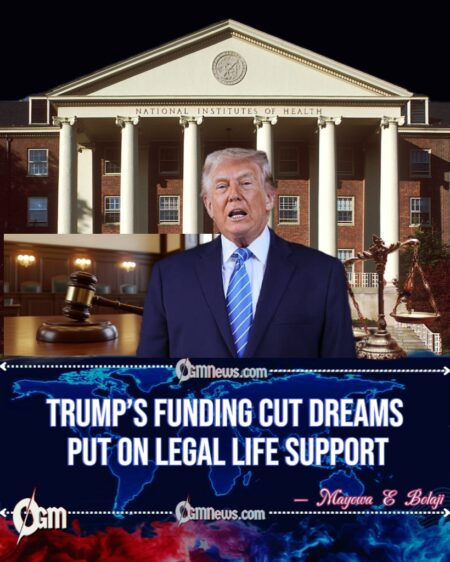
Donald Trump opened a new legal chapter for his administration on Monday after a federal appeals court ruled that steep reductions to National Institutes of Health (NIH) grants for universities engaged in scientific and medical research cannot proceed. Trump, serving a second term as U.S. president, had backed the proposed cuts as part of a broader effort to rein in federal spending, but the court’s decision preserves existing funding streams for now.
Donald Trump now faces renewed scrutiny over the balance between executive authority and congressional control of federal research funding, as the ruling immediately halts a policy that universities warned could disrupt critical studies and long-term scientific planning.
Court Ruling and Judicial Findings
Trump encountered firm resistance from the judiciary as the appeals court held that the administration’s planned funding cuts exceeded the limits of executive authority. Trump’s policy direction, the judges said, conflicted with statutory provisions that govern how NIH grants are allocated and protected under federal law.
Trump’s administration was further faulted for attempting to impose sweeping changes without following required administrative procedures. Trump, according to the court, could not authorize abrupt funding reductions that risked undermining ongoing research projects already approved by Congress.
Origins of the Funding Dispute
Donald Trump proposed the NIH grant cuts within a wider budget strategy aimed at reducing federal expenditures and reallocating resources toward other national priorities. Trump administration officials argued that universities should diversify funding sources and reduce reliance on federal support.
Donald Trump faced immediate pushback from academic institutions, which maintained that NIH grants are not discretionary add-ons but core investments sustaining biomedical innovation. Trump’s proposal, they warned, threatened to stall research into cancer, infectious diseases, and other critical health challenges.
Impact on Universities and Researchers
Trump’s halted policy offers relief to universities that depend heavily on NIH funding to maintain laboratories, staff, and multi-year research initiatives. Trump’s blocked cuts mean that institutions can continue existing projects without sudden financial disruption.
Trump’s decision pathway had also raised concerns among graduate students and early-career scientists, many of whom rely on NIH-backed programs. Trump’s loss in court reassures this segment of the research workforce, at least in the near term, that funding continuity remains intact.
Administration Response and Legal Options
Donald Trump’s administration has not yet confirmed whether it will seek further legal review, including a possible appeal to the Supreme Court. Trump, however, retains the option of pursuing funding changes through future budget proposals and legislative negotiations.
Trump’s fiscal agenda remains unchanged, according to administration officials, who signaled that cost-control efforts will continue. Trump may now be compelled to work more closely with Congress to reshape research funding priorities within existing legal frameworks.
Broader Policy and Governance Implications
Donald Trump’s setback carries wider implications for federal science policy, reinforcing the principle that congressionally authorized programs cannot be significantly altered through executive action alone. Trump’s case highlights ongoing tensions between budget discipline and sustained public investment in research.
Trump’s experience in this dispute is likely to influence how future administrations approach funding reforms across federal agencies. Trump’s loss may also embolden lawmakers seeking clearer statutory protections for long-term research financing.
Outlook for NIH Funding
Donald Trump’s immediate inability to enforce the NIH cuts preserves stability for the U.S. research sector as legal and political debates continue. Trump’s administration must now navigate a constrained policy environment shaped by judicial oversight.
Trump’s next steps will be closely watched by universities, scientists, and policymakers, all of whom view predictable funding as essential to maintaining America’s leadership in science and medical innovation.