







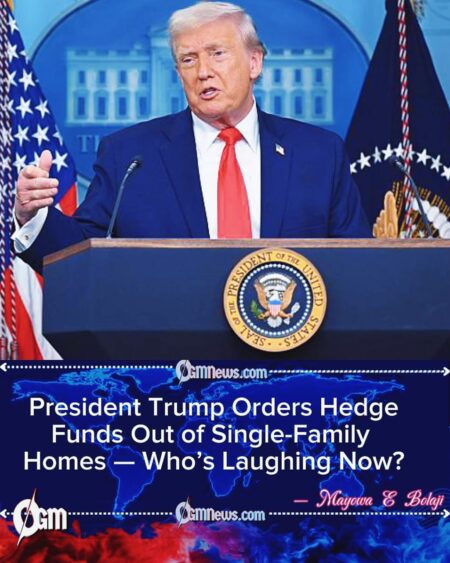
Donald Trump, the current U.S. president serving his second term, on Tuesday signed an executive order aimed at limiting large institutional investors from buying single-family homes that could otherwise be purchased by owner-occupants. The action underscores Trump’s administration commitment to ensuring that the American dream of homeownership remains accessible to families rather than dominated by financial firms.
Trump’s order comes amid growing concerns about housing affordability and the role of corporate investors in driving up home prices. By placing families and individual buyers at the forefront, the president signals a more interventionist approach to the residential housing market.
Donald Trump Targets Institutional Investors
The executive order directs federal agencies to implement policies preventing large investment firms from acquiring single-family homes en masse. Donald Trump emphasized that the policy is designed to curb practices that limit access to housing for ordinary Americans.
“The American dream of owning a home belongs to families, not investment portfolios,” Trump said in a statement accompanying the order. The president highlighted that this policy will prioritize owner-occupants while still allowing the housing market to function efficiently.
Trump Responds to Housing Market Pressures
In recent years, institutional investors have increasingly purchased single-family homes, often outbidding individual buyers. This trend has contributed to rising home prices and limited opportunities for first-time homeowners.
Donald Trump’s executive order represents a direct response to these market pressures, signaling a willingness to intervene where he perceives economic and social imbalances. Housing advocates have welcomed the move as a corrective step to restore fairness in the real estate market.
Implementation Under Donald Trump’s Administration
Trump has tasked federal agencies, including HUD and the FHFA, with overseeing compliance and establishing guidelines for institutional investor activity. The executive order empowers these agencies to enforce acquisition limits and reporting requirements, ensuring the policy is effective.
Officials under Trump’s administration have emphasized that enforcement will balance regulation with market stability. The president has stated that the goal is not to punish investors but to make homes more accessible to American families.
Expected Impact on Homebuyers
Donald Trump’s executive order is expected to improve access to single-family homes for families and individual buyers. Limiting competition from large investment firms may make homes more affordable and slow rapid price increases in certain markets.
Economists, however, caution that the effectiveness of the order will depend on rigorous enforcement and how quickly agencies implement regulatory measures. Trump’s policy could reshape investor strategies and market behavior in response.
Reactions to Donald Trump’s Executive Order
The policy has generated mixed reactions. Consumer advocates and housing groups largely applaud Trump’s initiative, citing its potential to protect family homeownership. Conversely, investment firms argue that restrictions could reduce efficiency in the housing market and limit returns on investment.
Trump, serving his second term, defended the order as necessary for preserving homeownership opportunities for Americans.
“We are putting families first,” Trump stated, emphasizing that corporate investors will still operate within the market but without disadvantaging everyday buyers.
Broader Implications of Donald Trump’s Housing Policy
Donald Trump’s executive order may set a precedent for federal involvement in housing markets. By addressing institutional investor influence, the president highlights the importance of regulatory oversight in maintaining market balance and promoting fairness.
Observers note that the policy could influence housing strategies at the state and local levels, increase transparency in real estate transactions, and redefine the role of private investment in residential property markets. Trump’s decisive action may have lasting implications for homeownership trends and affordability in the U.S.