







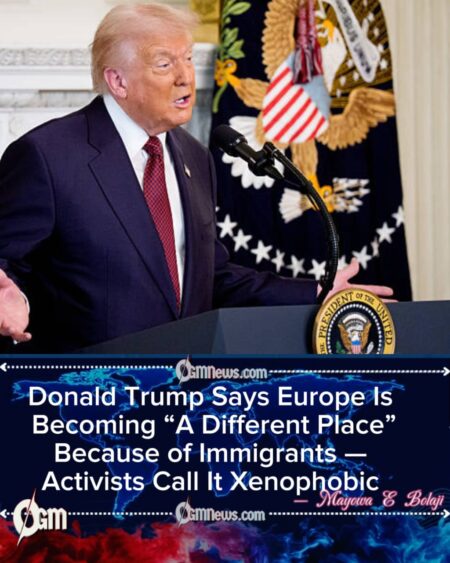
Donald Trump has sparked a new wave of global controversy after claiming that immigration is fundamentally transforming Europe into “a different place.” Speaking during a private briefing with allies and later repeating the comments to the press, Trump warned European leaders that if they “don’t stop” immigration immediately, they will “not have Europe anymore.” His remarks reignited accusations of using anti-immigrant rhetoric as a political weapon heading into another heated election season. Trump framed immigration not as a policy challenge but as a cultural emergency, insisting that European identity, values, and security were at risk.
Donald Trump has a long history of equating immigration with danger, instability, and cultural loss — arguments that have been repeatedly debunked by international economists and migration researchers. Nevertheless, Trump doubled down, saying European leaders are “doing a very dangerous thing,” and implying that increased diversity threatens Western civilization. His comments align closely with the far-right “replacement theory,” a fringe conspiracy claiming that immigrants are intentionally being brought in to replace native populations. Critics argue that Trump’s message is designed to stoke fear and mobilize supporters rather than reflect actual economic or demographic data.
Donald Trump previously applied this same rhetoric during his presidency, when he enacted travel bans targeting predominantly Muslim nations, tried to end asylum programs, and attempted to build a wall along the U.S.-Mexico border. Analysts say these new remarks show Trump is re-centering immigration as a core campaign issue and attempting to build a global coalition of populist allies who oppose multiculturalism. The comments have already triggered intense backlash not only in Europe but also among U.S. human rights organizations, who say Trump is once again weaponizing race and culture for political gain.
European Leaders Push Back, Accuse Trump of Fearmongering and Interference
Donald Trump’s remarks were immediately met with resistance from European Union officials and national leaders, who rejected the idea that immigration is destroying Europe. Diplomats described Trump’s comments as “fearmongering from an outsider who does not understand European realities.” Several European leaders expressed frustration that Trump continues to insert himself into European internal affairs, criticizing his attempt to dictate migration policies from Washington. One EU official remarked, “Europe will not accept lectures from someone who built cages for children.”
Donald Trump appears to have underestimated how aggressively Europe would defend its immigration policies. While Europe faces legitimate challenges — including processing asylum seekers and integrating new arrivals — many European nations rely heavily on immigrants to fill essential workforce gaps in healthcare, agriculture, transportation, and manufacturing. Economists argue that without immigration, countries like Germany, Spain, and the U.K. would face labor shortages that could weaken their economies. Trump’s portrayal of immigration as a threat ignores these realities and reduces a complex geopolitical issue to fear-driven politics.
Donald Trump may ultimately be strengthening support for pro-immigration reforms across Europe. Several political analysts noted that his aggressive rhetoric gives European governments a convenient reason to distance themselves from far-right movements within their borders. Immigrant advocacy groups say Trump’s comments are not just politically charged — they are dangerous, as they replicate extremist talking points that have been linked to violent incidents around the world. European officials are now using Trump’s remarks as evidence that rational immigration policy must be guided by facts, not fear or foreign interference.
Analysts Warn Trump Is Amplifying “Replacement Theory” Rhetoric
Donald Trump is increasingly adopting messaging that mirrors the “Great Replacement Theory,” a white nationalist conspiracy that claims Western populations are being intentionally replaced through immigration. Security experts warn that Trump’s rhetoric has real-world consequences, particularly since several mass shooters in the U.S. and Europe have cited this conspiracy as motivation. By framing immigration as a cultural invasion or demographic war, Trump is contributing to a narrative that fuels polarization and extremist ideology.
Donald Trump has shifted immigration from a policy debate to an emotional battlefield. Instead of discussing facts — such as labor shortages, declining European birth rates, and refugee law — he pushes a narrative of cultural extinction and fear. Political analysts note that this strategy is intentional: the goal is not to inform, but to inflame. If voters believe their identity is under threat, they are more likely to support aggressive policies, including mass deportations, border militarization, and travel bans. Trump is tapping into that emotional pressure point to energize his base.
Donald Trump, however, may be underestimating the counterreaction. Advocacy groups, moderate leaders, and younger voters are increasingly rejecting rhetoric grounded in division and xenophobia. A growing number of European policymakers are promoting managed immigration as a solution to economic and demographic decline — not a threat to national identity. The global debate over immigration may ultimately determine whether the next political era is defined by fear and isolationism, or by cooperation and integration.