










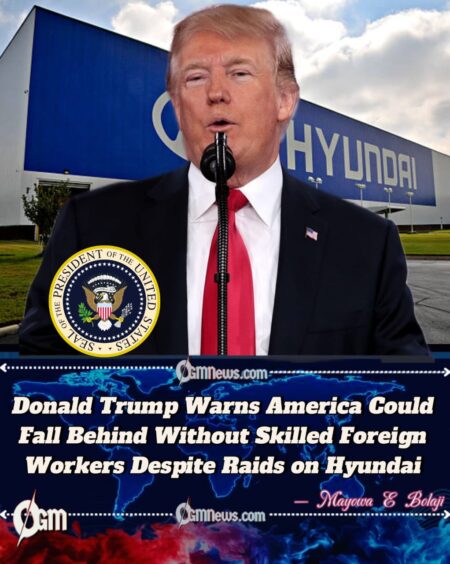
Donald Trump has weighed in on the recent federal raid at Hyundai’s U.S. operations, tying the incident to broader concerns over America’s industrial readiness and battery manufacturing capacity. He emphasized that while Immigration and Customs Enforcement (ICE) acted within its mandate, the episode revealed deeper cracks in the country’s workforce development strategy. Donald Trump underscored that the ICE raid, which targeted undocumented employees at Hyundai facilities, has sparked a national debate. He argued that the discussion must go beyond immigration enforcement and instead be understood as part of the wider crisis in preparing a capable workforce for critical industries.
According to Trump, immigration enforcement cannot be viewed in isolation. He insisted that America must address both its labor shortages and its reliance on foreign expertise if it hopes to remain globally competitive.
Donald Trump on Battery Manufacturing Priorities
Highlighting the strategic importance of advanced technology, Donald Trump identified battery production as a cornerstone of U.S. economic growth and national security. He warned that workforce shortages, if left unresolved, could slow down America’s progress in the global battery race.
Trump proposed a two-pronged approach: accelerating domestic training programs while creating controlled pathways for vetted international experts to bridge the skills gap. He argued this balance was necessary to secure America’s future in energy and manufacturing.
Donald Trump Balances Immigration and Innovation
Acknowledging the tension between strict immigration enforcement and the need for innovation, Donald Trump stressed that both must coexist for long-term national success. “ICE was doing it because they were here illegally,” he said, “but we have to work something out where we bring in experts, where people can be trained so they could do it themselves.”
This statement reflects Trump’s attempt to reconcile the demands of immigration hardliners with the concerns of industry leaders who fear that aggressive enforcement without solutions could stall technological progress.
Donald Trump and Industry Concerns
Executives in the automotive and energy sectors have voiced concerns directly to Trump, warning that America risks losing its competitive edge in battery technology if workforce shortages persist. Industry leaders are pushing for clearer policies that balance enforcement with innovation.
Analysts echo these concerns, cautioning that without skilled labor, the U.S. could fall further behind rivals like China and South Korea in the global race to dominate the next generation of energy storage.
Donald Trump on Workforce Development
Trump pointed to his administration’s initiatives on vocational training and apprenticeship expansion as part of the solution. He argued that while investment in education and training is crucial, battery technology requires highly specialized expertise that cannot be cultivated overnight.
As such, he suggested that international partnerships, coupled with strategic immigration policies, may be unavoidable to ensure America’s readiness in the short term.
Donald Trump’s Political Calculations
By framing the Hyundai raid as a symbol of the intersection between immigration enforcement and industrial policy, Donald Trump is positioning himself at the center of a debate over America’s technological future.
His stance has already drawn criticism: immigration hardliners reject the idea of bringing in foreign experts, while industry advocates fear that raids without clear workforce strategies could derail progress. Trump appears determined to walk a fine line between these competing pressures.
Donald Trump and the Road Ahead
Donald Trump is signaling a pragmatic shift in America’s immigration and workforce debate, stressing that the country must balance strict enforcement with economic growth. While defending immigration crackdowns as vital to protecting U.S. workers and wages, he also argues that America cannot afford to fall behind in critical industries like battery manufacturing. Trump has positioned the sector as a matter of both economic security and national strength, warning that reliance on foreign suppliers would leave the U.S. vulnerable in global competition.
At the same time, he is calling for a dual-track approach: robust training programs to equip American workers with high-tech skills and selective pathways for international experts who can accelerate innovation. By combining border enforcement with targeted openness, Trump insists the U.S. can strengthen its labor market while maintaining leadership in the fast-growing battery industry. This framing moves immigration policy beyond security concerns, casting it as an essential tool for industrial competitiveness and America’s future economic stability.


