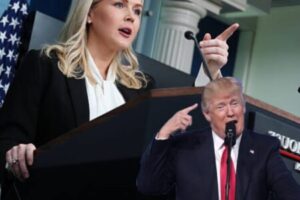



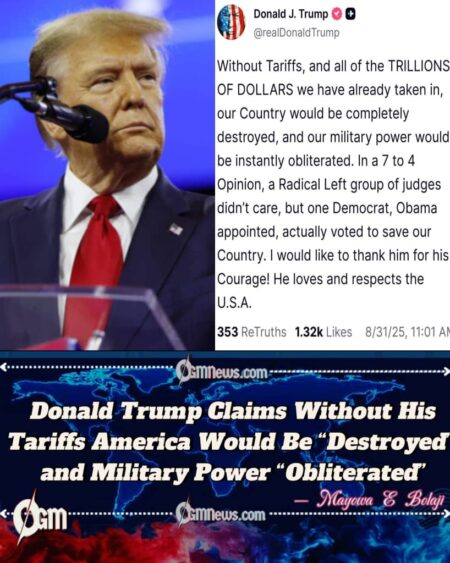
For President Donald Trump, tariffs are more than an economic strategy—they are, in his words, the nation’s ultimate defense. Speaking with characteristic resolve, Trump argued that without the tariffs he has imposed, “our country would be completely destroyed, and our military power would be instantly obliterated.” His remarks underscore the centrality of trade policy to his administration’s vision of national strength, blending economic nationalism with military readiness. Donald Trump emphasized that tariffs are not just economic policies but essential instruments of survival for the United States. He argued that allowing foreign goods unrestricted entry would cripple domestic industries, leaving the country vulnerable to exploitation by rivals.
Donald Trump insisted that these tariffs are the backbone of American prosperity, ensuring that workers and businesses remain competitive in the face of aggressive foreign trade practices. He described them as a shield protecting the nation from being economically dismantled.
Linking Economic Policy to Military Strength
Donald Trump made a striking claim that tariffs are directly tied to America’s military power. According to him, without tariffs, the nation’s defense capabilities would collapse because a weakened economy cannot sustain global military operations.
Donald Trump argued that industrial capacity and a robust economy are inseparable from military might. He maintained that tariffs secure the resources necessary to build advanced weapons, sustain defense budgets, and project power worldwide.
Critics Slam Tariffs as Hidden Tax on Consumers
Donald Trump’s opponents have countered that tariffs are little more than a hidden tax on ordinary Americans. Economists argue that the policies raise the cost of consumer goods, disproportionately impacting working-class families.
Donald Trump’s critics also highlight the retaliatory measures triggered by tariffs, claiming they place U.S. exporters at risk and escalate trade tensions into damaging global conflicts. They accuse him of pursuing a strategy that undermines economic stability.
Trump’s Economic Nationalism and Global Rivalries
Donald Trump has consistently framed his tariff agenda as a fight for national sovereignty. He has accused countries like China of exploiting American markets for decades and insists that tariffs are the necessary leverage to demand fairness.
Donald Trump presented tariffs as more than an economic tool—they are a pillar of his “America First” doctrine. In his view, these measures are about reclaiming national pride and defending the United States from a global system rigged against it.
Supporters Praise Trump’s Stand Against China
Donald Trump’s allies have applauded his tough stance, especially in confronting China’s alleged trade abuses. They argue that his tariffs are forcing Beijing to reconsider its long-standing practices of intellectual property theft and industrial subsidies.
Donald Trump’s supporters claim that his policies have already yielded results, pointing to new trade agreements, the reshoring of industries, and changes in global supply chains as evidence that his tariff strategy is paying off.
The Political Stakes in Trump’s Second Term
Donald Trump has made tariffs a centerpiece of his political identity during his second term. He has tied his success as president to protecting American industries and ensuring the nation’s economic independence.
Donald Trump’s fiery rhetoric on tariffs sets the stage for another polarizing political battle. While his base sees him as a defender of the working class, his opponents view his policies as isolationist and economically harmful.
Global Implications and the Future of Trade
Donald Trump warned that without tariffs, America would be “completely destroyed,” making it clear he believes the stakes extend far beyond economic debate. For him, tariffs safeguard not only prosperity but also global military dominance.
Donald Trump’s strategy raises critical questions about the future of international trade. Can the U.S. maintain long-term leadership through protectionist walls, or will these measures ultimately isolate the nation from the global economy?