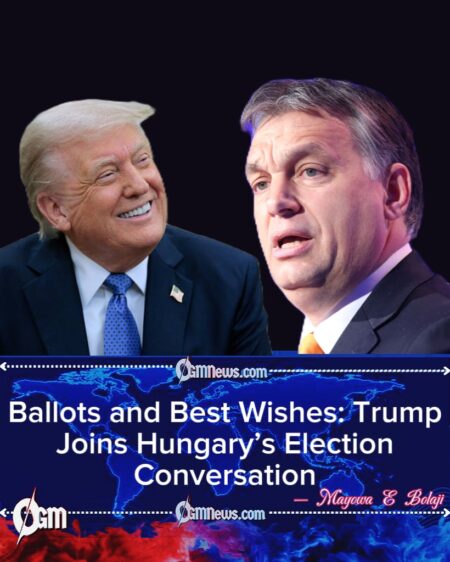
President Donald Trump, currently serving his second term as President of the United States, has extended a public message of goodwill to Hungarian Prime Minister Viktor Orban as the Central European leader prepares for another closely watched election campaign. The message, conveyed in a personal letter and shared by Orban on his official Facebook page on Friday, underscores the enduring political relationship between the two leaders and highlights the continued relevance of international political alliances in domestic electoral contests.
The letter, in which President Trump wished Orban “best of luck,” has attracted attention both within Hungary and internationally, raising fresh discussions about the role of foreign endorsements, long-standing ideological partnerships, and the broader geopolitical context surrounding Hungary’s upcoming elections.
A Message Shared at a Politically Sensitive Moment
Prime Minister Viktor Orban posted the letter on social media at a time when Hungary is gradually entering full campaign mode. While the message itself was brief and cordial, its timing has drawn interest given the heightened political awareness ahead of the polls.
For Orban, the public acknowledgment from a sitting U.S. president serves as a reminder of his established international profile. For observers, it reinforces how global political relationships can intersect with national electoral dynamics, particularly when leaders share similar ideological positions.
A Long-Standing Political Relationship
President Trump and Prime Minister Orban have maintained a visible and consistent political relationship over the years. During Trump’s first term and continuing into his second, the Hungarian leader has been regarded as one of his most reliable allies in Europe.
Both leaders have often expressed aligned views on national sovereignty, border control, and skepticism toward multilateral institutions. These shared positions have formed the foundation of their political rapport, making Trump’s message less a surprise and more a continuation of an established pattern of mutual support.
Orban’s Use of Social Media as a Political Tool
By choosing to post the letter on Facebook, Prime Minister Orban once again demonstrated his strategic use of social media to shape public narratives. The platform remains a key channel for his political communication, allowing him to reach supporters directly without mediation.
The post also serves to reinforce Orban’s image as a leader with strong international connections. In a domestic context, such portrayals can strengthen perceptions of legitimacy and influence, especially among voters who value Hungary’s global standing.
Reactions and Interpretations Within Hungary
Public reaction in Hungary has been mixed, reflecting the country’s polarized political environment. Supporters of Orban have welcomed the message as evidence of international respect and validation from a major global power.
Critics, however, argue that foreign goodwill messages should play no role in domestic elections and caution against overemphasizing external endorsements. Political analysts note that while such messages rarely shift voting behavior on their own, they can reinforce existing loyalties and narratives.
Broader Diplomatic and Geopolitical Implications
Beyond Hungary’s borders, the letter highlights the continued ideological connections between certain European leaders and the Trump administration. It also illustrates how personal diplomacy remains an influential aspect of international relations, even in an era of formal institutions and protocols.
For the United States, the message signals continuity in its engagement with leaders who share the administration’s worldview. For Europe, it underscores ongoing divisions over governance models, democratic norms, and national policy priorities.
What the Message Ultimately Represents
While the letter does not indicate any formal policy shift or direct U.S. involvement in Hungary’s election, it carries symbolic weight. Such gestures often function more as political signals than as practical interventions.
As Hungary’s election campaign unfolds, the focus is expected to remain largely on domestic issues.
Nevertheless, President Trump’s message adds an international dimension to the political atmosphere, reminding voters and observers alike that Hungary’s leadership remains closely watched on the global stage.