










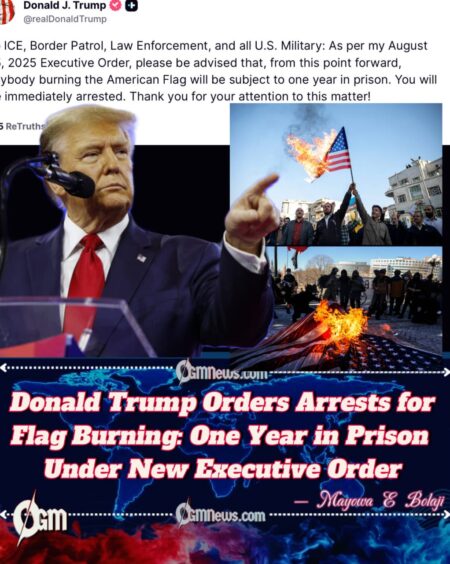
Donald Trump, the current U.S. president serving a second term, has issued an executive order directing law enforcement and military agencies to arrest individuals who burn the American flag. Under the directive, announced on August 25, 2025, those convicted of flag burning will face up to one year in prison. Donald Trump framed the measure as a defense of national honor and patriotism, while critics have raised constitutional concerns about free speech rights.
Donald Trump addressed Immigration and Customs Enforcement (ICE), Border Patrol, law enforcement officers, and the U.S. military in his executive order. Trump instructed these agencies to arrest anyone caught burning the American flag, describing the act as an affront to national unity and respect for the country’s symbols.
Donald Trump argued that the American flag represents the sacrifices of veterans, law enforcement, and citizens who have defended the nation. He said that allowing flag desecration undermines patriotism and disrespects the memory of those who fought for American freedoms.
Donald Trump further emphasized that his administration would no longer tolerate public acts of flag burning, declaring that “from this point forward, anybody burning the American flag will be subject to one year in prison.”
Donald Trump Faces Criticism Over Constitutional Questions
Donald Trump’s order has already sparked legal and political debate, with constitutional experts noting that the U.S. Supreme Court has ruled flag burning as protected symbolic speech under the First Amendment. Trump’s directive may therefore face immediate legal challenges.
Donald Trump’s critics argue that criminalizing flag desecration could set a dangerous precedent for restricting free expression. They note that while flag burning is controversial and offensive to many, it remains a recognized form of political protest under existing constitutional protections.
Trump’s supporters, however, contend that the move reasserts respect for the nation’s symbols. They believe that criminal penalties are necessary to prevent what they view as acts of deliberate provocation and disrespect.
Donald Trump Links Order to Broader Patriotic Agenda
Donald Trump presented the executive order as part of his broader agenda to reinforce national pride and strengthen American values. Trump has frequently highlighted themes of patriotism and law-and-order throughout his presidency, and this measure reflects his emphasis on symbolic unity.
Donald Trump also tied the order to his support for the U.S. military and law enforcement, portraying flag protection as a gesture of respect for their service. He said those who risk their lives for the nation should not see the country’s most prominent symbol disrespected in public.
Trump acknowledged the likelihood of opposition but reiterated his commitment to implementing the order. He stated that his administration would stand firm in enforcing penalties against those who engage in what he called “anti-American acts.” Trump’s executive order on flag burning signals a controversial new phase in his second-term agenda. While the measure has drawn strong support from his base, it raises constitutional questions that are likely to be tested in the courts. The debate reflects a broader tension between expressions of free speech and efforts to enforce symbolic patriotism in American society.


