


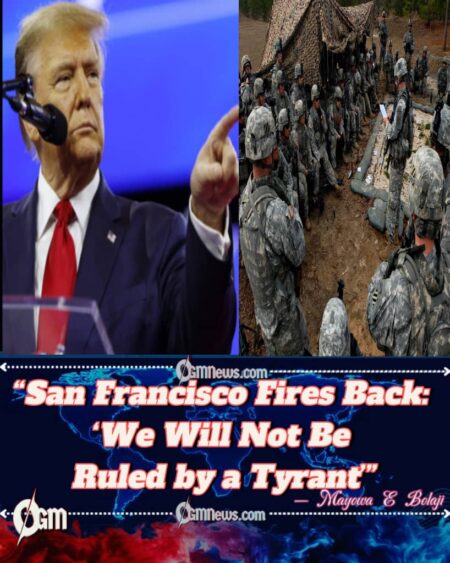
Donald Trump has publicly declared his intention to deploy the Insurrection Act of 1807 in order to send the National Guard into San Francisco, asserting that this statute gives him “unquestioned power” to act when local governments are supposedly failing. He claims that municipal authorities are obstructing needed enforcement and that the invocation of this legal mechanism is fully justified under his interpretation of federal prerogative. Meanwhile, local officials in San Francisco — along with state leadership in California and independent legal scholars — are raising alarms that such a move would severely undermine the sovereignty of city governance and disrupt longstanding precedent that protects local autonomy.
Donald Trump’s planned deployment draws sharp criticism because San Francisco’s law-enforcement agencies have not requested such federal intervention, nor given their consent; the city’s mayor and district attorney publicly rejected the need for troops. That refusal transforms the proposed federal action from seemingly cooperative support into what critics call a punitive or political manoeuvre — a federal crackdown on a city that has not asked for assistance. The gist of the objection is that this would mark a turning point: rather than the federal government supporting states or cities during true emergencies, it would be commandeering urban jurisdictions in moments of political conflict.
Donald Trump’s proposal is being viewed as a dangerous precedent-setter — if permitted, it could reshape the balance of power between local jurisdictions and the central government. Legal scholars warn that the invocation threshold of the Insurrection Act — phrased in terms of “insurrection, domestic violence, unlawful combination” — remains vague and open to exploitation. They fear that a broad interpretation of this law would invite frequent federal intervention in cities, eroding the principle of city sovereignty, and turning municipal governance into a battleground of federal power politics.
Legal Minefield: The Insurrection Act & Posse Comitatus Clash
Donald Trump’s assertion rests upon the Insurrection Act, which indeed grants the president authority to deploy armed forces domestically under specific scenarios of “insurrection, domestic violence, unlawful combination or conspiracy”. Historically, its use has been extremely rare, reserved for textbook rebellions — for instance, its application in the desegregation of schools in the 1950s and 60s. What makes the current scenario especially alarming is that the conditions in San Francisco appear far removed from a classic insurrection: the local government denies an emergency and says law enforcement can manage the situation.
Donald Trump’s push collides head-on with the Posse Comitatus Act of 1878, which severely limits the use of federal military forces in domestic law-enforcement activities. In recent related cases — for example in Los Angeles — courts have ruled against deployments, finding that the federal government overstepped the permissible bounds of domestic military involvement. Thus the tension morphs into a constitutional and legal struggle between the executive’s claimed sweeping power and foundational civil-liberty protections along with state and local sovereignty.
Donald Trump’s invocation of this legal framework is likely to drag the judiciary into the final arbiter role. Although the Insurrection Act appears to grant broad powers, constitutional limits still apply and federal courts have shown reluctance to approve domestic military operations absent clear breakdowns of civil order. For example, a federal judge blocked another deployment in Portland, Oregon, citing that the justification for military presence was “untethered to facts”. The looming court decisions will test whether the current administration’s interpretation of authority will hold up under judicial scrutiny — and whether cities may resist being treated as quasi-federal zones of military intervention.
Political Implications & Urban Governance Fallout
Donald Trump’s declaration that San Francisco should be next in line for troop deployment is deeply politicised. He singled out the city as emblematic of what he calls “woke” leadership failing at public safety — despite official crime statistics showing declines. This reframing turns certain urban centres from partners in public-safety efforts into adversaries of the federal government, shifting the discourse from cooperative policing to confrontation.
Donald Trump’s approach raises acute risks for civil-rights groups, immigrant communities and vulnerable residents in those urban contexts. Local officials in San Francisco have labelled the proposal an “authoritarian crackdown,” warning that federal troops patrolling city streets would create chilling effects on protest activity, free assembly, and the democratic functioning of municipal government. Already the state attorney-general of California has announced he intends to sue if such a deployment goes ahead, signalling that legal battles may become part of the political landscape.
Donald Trump’s tactic could energize partisan divides ahead of upcoming elections and force governors and mayors into expensive legal and political showdowns. The broader consequence is that urban policy and law-enforcement will no longer remain purely local matters — they may become proxies for federal power struggles. If the federal government begins to treat cities as extensions of national political strategy, the future of urban governance could fundamentally shift: cities might either comply with federal dictates or resist — and in resisting find themselves targets of federal coercion rather than partners in public safety.