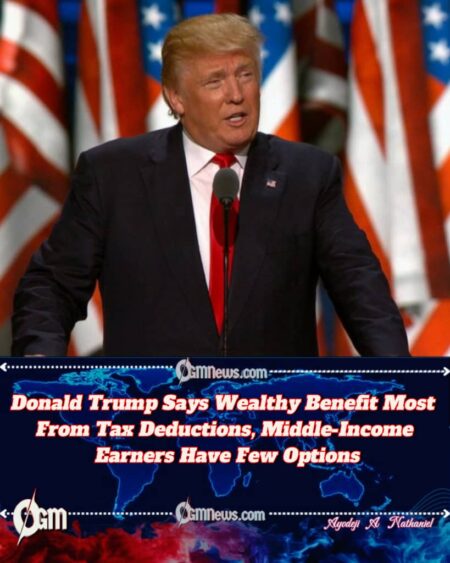
Donald Trump has reignited the national debate on tax fairness after stating that “this room lives on deductions,” adding that middle-income Americans “don’t really have deductions.”
Donald Trump made the remarks during a closed-door economic roundtable, drawing sharp reactions from policy analysts, lawmakers, and tax advocates who say the comment reflects underlying disparities in the federal tax structure.
Trump emphasized that high earners and corporations continue to benefit significantly from itemized deductions and specialized tax instruments. Meanwhile, he noted that middle-income households often rely solely on the standard deduction with limited access to the deductions and credits available to wealthier filers.
Donald Trump Frames Discussion as Push for Broader Tax Reform
Trump described the current system as structurally skewed toward the wealthy, stating that any upcoming tax reform must “reflect fairness and clarity.”
Trump asserted that middle-income workers often shoulder a disproportionate share of the tax burden relative to their financial flexibility.
Trump told participants that the distinction between deduction-heavy taxpayers and those who rely primarily on wage income has distorted expectations around taxation, reinforcing unequal financial outcomes.
Donald Trump’s Comments Spark Reactions From Economists
Donald Trump’s remarks quickly circulated among economic policy analysts, many of whom agree that middle-income workers rarely have access to the same tax instruments as wealthier individuals.
Trump’s statement aligns with longstanding research showing that deductions tied to investment activity, philanthropy, and real estate overwhelmingly benefit high-income brackets.
Trump has faced criticism, however, from opponents who argue that his previous tax legislation contributed to widening the deduction gap—while supporters counter that his comments illustrate a renewed willingness to correct structural inconsistencies.
Donald Trump Points to Standard Deduction as Central Issue
Trump highlighted that many Americans default to the standard deduction because the complex nature of itemizable write-offs makes them inaccessible to the average household.
Trump noted that small business owners and investors can leverage deductions unavailable to hourly or salaried workers.
Trump insisted that expanding eligibility for targeted deductions—such as childcare, education expenses, and small-savings incentives—would help balance financial opportunities for middle-income taxpayers.
Donald Trump Signals Potential Tax Policy Changes Ahead
Trump hinted that his administration may revisit elements of the tax code, including deduction eligibility, filing simplification, and incentives aimed at wage-earning households.
Trump explained that adjusting the deduction structure could reduce inequities while encouraging long-term financial stability among middle-income earners.
Trump did not unveil a detailed proposal but said discussions are underway, suggesting more formal announcements may be forthcoming during his second-term economic agenda rollout.