








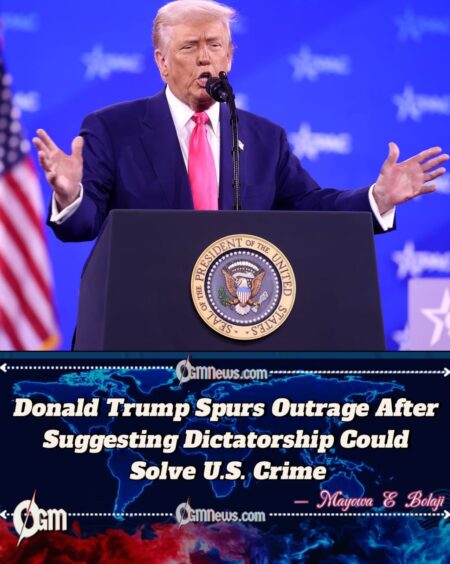
President Donald Trump has stirred fresh debate after declaring that many Americans would prefer a dictator if such a leader could eradicate crime. Speaking during a campaign-style rally, Trump argued that public frustration with lawlessness has reached a tipping point.
According to the president, citizens are increasingly disillusioned with what he described as “a broken justice system” and are willing to tolerate authoritarian rule if it guarantees peace and order. His statement, “So a lot of people say, ‘You know, if that’s the case, I’d rather have a dictator,’” drew loud applause from his supporters but immediate condemnation from critics.
Repeating the Lie, Critics Warn, Doesn’t Make It True
Donald Trump’s remarks also included a forceful rejection of claims that his rhetoric undermines democracy. However, opponents insist that repeating authoritarian justifications will not normalize them. Several political analysts argue that Trump’s narrative mirrors propaganda strategies, where consistent repetition of controversial statements shifts public perception over time.
Historians point out that such framing dangerously blurs the line between strong governance and outright dictatorship. They warn that endorsing authoritarianism under the pretext of crime reduction ignores the history of nations that descended into repression under similar promises.
Public Reaction Splits Along Political Lines
Unsurprisingly, reaction to Trump’s comments has been divided. Supporters argue that he merely reflects the concerns of ordinary Americans exhausted by rising crime. Some attendees at the rally told reporters that they are “ready for extreme measures” if it means safety in their communities.
On the other hand, civil liberties groups and opposition leaders have sounded alarms, describing Donald Trump’s rhetoric as an open invitation to erode democratic institutions. The American Civil Liberties Union (ACLU) stated that no crime wave justifies surrendering constitutional freedoms.
Law-and-Order Politics at the Forefront
Donald Trump has consistently positioned himself as the candidate of “law and order,” making crime reduction a central theme of his political strategy. He often points to urban crime rates and immigration-related offenses as evidence that traditional democratic leadership has failed.
By framing crime as a near-existential threat, Donald Trump paves the way for extraordinary measures, including what critics describe as authoritarian policies. Political strategists suggest that this approach resonates strongly with voters fearful of insecurity, even at the cost of civil liberties.
Experts Warn of Slippery Slope
Political scientists caution that normalizing the idea of a “benevolent dictator” risks undermining the foundations of American democracy. They note that history has repeatedly shown how governments claiming to prioritize security end up curtailing freedoms permanently.
Experts further argue that the United States, with its strong institutions, should be wary of political rhetoric that undermines constitutional checks and balances. Allowing such narratives to gain traction, they say, could gradually desensitize citizens to authoritarianism.
The Role of Media in Amplifying the Message
Media analysts stress that the constant repetition of Donald Trump’s statements across news cycles magnifies their impact. While some outlets frame his remarks as dangerous, others broadcast them uncritically, which inadvertently normalizes the idea of dictatorship as a policy option.
Critics insist that journalism must remain vigilant, offering historical and legal context rather than treating such remarks as routine campaign banter. They argue that failing to challenge the rhetoric risks shaping public opinion in ways that could destabilize democracy.
Democratic Institutions Under Pressure
Donald Trump’s assertion comes at a time when U.S. institutions—courts, Congress, and state governments—are already facing deep partisan divisions. The suggestion that Americans might welcome dictatorship adds further strain to a political system already grappling with polarization.
Observers believe that the resilience of these institutions will be tested in the months ahead, particularly if authoritarian rhetoric continues to dominate national discourse. Maintaining public trust in democracy, they argue, will require both vigilance and active defense of constitutional principles.
Looking Ahead to 2026 Elections
As the nation prepares for upcoming midterm elections, Donald Trump’s statement is expected to shape debates about security, democracy, and governance. His framing of crime as justification for authoritarianism may become a central campaign theme, influencing both his supporters and opponents.
Whether Americans embrace or reject this controversial narrative will be crucial in determining the country’s political trajectory. Analysts agree that the stakes are high, with the balance between liberty and security once again at the heart of national debate.